Posts

Dance Emotes in Fortnite Stir Up Controversy (Again….)

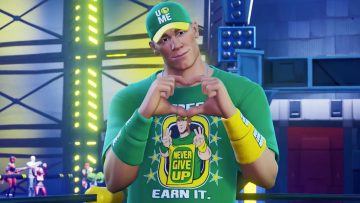
Our discussion today regarding the ability to copyright certain “signature” moves in games reminded me of Fortnite and some recent controversy that I’d like to share. Fortnite, like many multiplayer games, allows users to “emote” (i.e. the player’s avatar or character will project certain actions like a thumbs-up or dance for other players to see). Some of these emotes are unlockable or otherwise available to purchase in-game (see example of a John Cena avatar from Fortnite emoting below).

(https://www.ign.com/games/fortnite)

I remember a few years ago a dancer attempted to sue Epic Games for allegedly using their dance, “the floss” as an emote, without their consent (see: https://www.npr.org/sections/money/2019/02/12/694033450/fortnite-vs-backpack-kid-dance-battle-royale). More recently, a choreographer also attempted to sue Epic Games for using his dance moves as an emote (see https://www.nbcnews.com/pop-culture/pop-culture-news/choreographer-sues-epic-fortnite-emote-kyle-hanagami-rcna23075).

Thoughts?

“Am I playing a character, or am I being me?”

Hi everyone,

The question posed in class reminded me of a hot debate that happened last summer in one of my Facebook groups. The group consists of players, 25 years and older, who play the video game “Animal Crossing: New Horizons (ACNH)” (the group name: Animal Crossing for 25+).

For those of you who don’t know the game, ACNH lets you interact with different villagers (anthropomorphic animals) as you build and decorate a (once) deserted island to your liking. There are 400+ villagers, 10 of whom can live on your island at once. For the first six villagers, the game randomly assigns them (i.e., you don’t get to choose who comes onto your island). As the game progresses, villagers will tell you (the player) they want to leave the island, thereby making their spot vacant for other villagers to come onto the island.

Now, depending on perspective, there are some villagers who are visually attractive, and those who are not. Thus, if any of the villagers are visually unattractive, some players would want them to move out of their island ASAP. To do so, it was once rumoured that if you make a villager’s life “miserable” enough, they will ask to leave (this is now largely proven not true). The game was also designed so that if the player hits a villager 3 times, the villager would react in either a sad or angry manner. This supposedly reduced the villager’s interest in continuing to live on the island, and hence ask to leave (again, largely proven false). At the time though, many believed this to be true, and the Facebook group was filled with posts depicting players hitting villagers with a handheld net (see photo below, credit to Liam O’Malley).


(https://hard-drive.net/despised-animal-crossing-villager-cant-afford-to-move-away/)

When the wave of such posts started, there was also another wave of posts advocating for “kind play.” Hitting villagers, even in a game, was mean and cruel, and some even argued it showed “just how bad a person you really are inside.” To this, others argued that “it’s just a game,” and that such a way of playing is simply a way for people to relieve stress.

Now I throw it out to you:

If you engage in abusive behaviour in a game, are you being abusive? Or are you simply engaging in one way to play a game?

Class 2 – 9.14.22 “If Picasso Had Painted A Round Object…”

Slides & video below…

Jon

Welcome to the 15th Video Game Law Cohort @ Allard & Class 1 – 9.7.22 “Introduction (to the Course)”

As I was droning on to you about the intricate linkages between video-games and the metaverse which might at some future time result in us not being able to tell what is real and what is not, reality reminded us it’s not quite that malleable. The real wind outside literally took the wind out of those oratorical sails by blacking out our classroom. Begging the cheap philosophical question “Does the wind blow in the metaverse?” Well, apparently it can (https://futurism.com/now-you-can-feel-wind-and-temperature-while-in-virtual-reality; Sim Racing Studio Hurricane Wind Kit Review). Notwithstanding, the real wind in addition to creating a short break, also tanked the video recording of the class as the recorders (which are remote from the classroom) never restarted. A real world rebuttal to the metaverse if there ever was one. Lesson learned 😉

Slides from today are below…

Jon

Video Presentation: Is Streaming Fair Dealing?

Hi everyone!

I wrote my final paper on the topic of the legality of streaming. I was originally intended for my presentation to recap the whole issue. Unfortunately, there ended up being a lot more to say than I anticipated.

For my presentation, I’ve just provided a brief intro to the issue, then applied the Canadian fair dealing factors to game streaming to give an opinion on whether I think the defence would apply.


Enjoy!


Final Paper – Comparative Discussion on App Distribution on Mobile Smart Devices

Hi Everyone,

I decided to share my paper on mobile smart device app distribution markets. Looking at Apple v Epic for a while now, I found out that there were some very controversial findings in that case, such as the decision that iOS was not a product, that there was no market for mobile smart device operating systems, and that Apple Store and Google Play Store were competing in the same market, even though they are entirely different ecosystems. In this paper, I try to define app stores, legal controversies and issues, and critique Apple v Epic drawing comparisons to a similar anticompetition case in the European Union.

If you are so inclined to read my paper, I would be happy to discuss anything.

FinalPaper_Law 423C_Deniz Ozensoy


Best,


Deniz

Playing Video Games While Driving?

Hey everyone,

Just came across this article about Tesla’s new feature that allows drivers or passengers to play video games in their vehicle. Because of the prevalence of accidents caused by inattentive drivers, having video games in a vehicle accessible to the driver has raised concerns about the possibility that people may be injured or even killed as a result of distracted driving. The article states that the US’s National Highway Traffic Safety Administration has rules that require that in vehicle safety devices not be accessible to drivers while they are operating the vehicle, but the Tesla games simply require the user to press a button to confirm they are not a driver, but there is no mechanism for actually verifying this. It will be interesting to see if regulatory bodies step in to prevent Tesla from including video games in their vehicles, or if this is something we see more of as self-driving cars become more common.

The Law’s New Language?

Hey everyone, I hope your papers are going well. I wanted to share some fascinating research related to legal automation and linguistics that my former professor, Megan Ma, is doing, as I think has some relevance to our course. Her research specifically focuses on the code-ification of legal language, how that diverges from the current legal practices, and the advantages and challenges that code would present as the new language of law. Translating law into code would necessitate the hyper-simplification of “legalese” into machine-readable data that would leave no room for abstraction. Megan cites this code-ification as a solution to legal indeterminacies but also cautions that “[t]he law hinges on complicated sociopolitical relationships; metaphors that require latent understanding of temporal societal constructs,” making it potentially impossible to “translate such information into perfectly comprehensible instruction.”

I am attaching a teaser on her dissertation that she wrote for the Harvard International Law Journal and a podcast interview she did, both in 2020. I don’t know when it is going to be published, but also keep a lookout for her full PhD dissertation that she completed last week!


https://harvardilj.org/2020/04/the-laws-new-language/

False Start: EA Sports College Football Release Date

I figured everyone is likely going through some “News of the Week” withdrawals right now, so I wanted to pass along a funny situation that happened earlier this week.

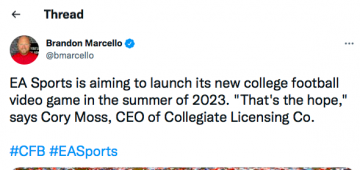
College football reporter Brandon Marcello re-sparked the rumour mill about the potential release date for the EA Sports College Football game last Thursday, tweeting the following:


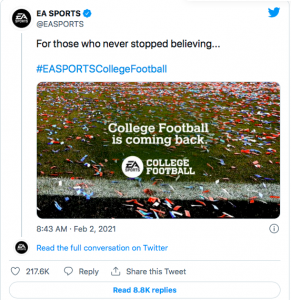
The college football community was (briefly) ecstatic. Rumours of when the game will be released have occurred throughout the year, dating back to February of 2021 when EA officially announced the reboot of the game, formerly known as NCAA Football:


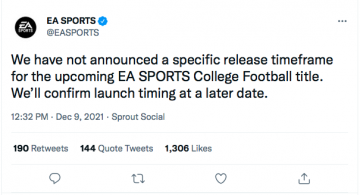
Unfortunately, like an offensive linemen making an improper adjustment before the snap, the tweet by Marcello was a false start. Only 4 hours later, EA was essentially forced to throw a flag on the play:


It appears the fans will have to continue to wait for the official release date. This exchange is merely the latest chapter in the unfolding drama that is the EA Sports College Football game.

Of course, the major development for EA and college football this year is that EA is now permitted to use the name, image and likeness (NIL) of the NCAA athletes. When EA originally made its reboot announcement in February, it did so on the basis that the players NIL would not be part of the game. This meant that the game would include generic, unrecognizable players. However, this all changed after the United States Supreme Court’s decision National Collegiate Athletic Association v Alston in July. Following that decision, the NCAA withdrew its NIL policies, and the athletes can now be compensated for their NIL, including by their replications in the EA sports game.

EA will most definitely be capitalizing on the popular college football market. It was reported that in the first two months after the NCAA withdrew their NIL policy, 60% of the total compensation for all athletes was going to college football players.

To recap, while it is now certain that the NCAA athletes will be included in the game, it is unclear when that game will be delivered. For now, it remains a mystery which lecture of a future video game law class will start with the slide “Happy EA Sports College Football Release Week”.

Links:

https://www.sportingnews.com/us/ncaa-football/news/ncaa-football-video-game-release-date-ea-sports/ey42a5w6fpbh11uvijcnuj0bq

https://www.forbes.com/sites/brianmazique/2021/03/11/ea-sports-college-football-release-date-and-details-leaked-report/?sh=7f6079735891

https://www.forbes.com/sites/andrewzimbalist/2021/10/27/nils-surrogate-markets-and-the-future-of-college-sports/?sh=5fd096261f27

Perkz barred from Fnatic: a loophole in regulating player transfers?

Hi everyone, I would like to share my thoughts on a piece of news that rocked the League of Legends esports scene last month. Below is a summary of background facts for context:

Backstory – skip if you know this already 😊

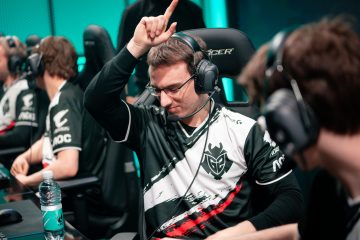
G2 Esports and Fnatic are two of the most popular teams in the LoL European Championships (“LEC”) and long-term rivals. G2’s star player, Luka “Perkz” Perković, has been playing with G2 since its founding in 2015 and has since become synonymous with the organization. Perkz originally played in the “Mid” position but swapped to the “AD Carry” role in 2019 when Fnatic’s then star mid-laner, Rasmus “Caps” Winther, defected to G2. The team was highly successful, winning multiple LEC splits back-to-back as well as the 2019 international Mid-Season Invitational, and placing second at the 2019 World Championships.

In early 2020, Perkz signed a long-term contract with G2 to play for them until November 2022. After his father passed away in mid-2020 due to cancer, Perkz informed G2’s CEO and founder, Carlos “Ocelote” Rodríguez, that he would like to swap back to the mid lane and join Fnatic, who was reportedly very interested in acquiring him. After hearing this, Ocelote took active steps to block calls/emails from Fnatic and arranged for Perkz to leave the LEC entirely, through a record-breaking US$8.9 million buyout agreement with American esports team, Cloud9. As a result of the buyout, Perkz has to leave Europe and play in the North American League Championship Series (“LCS”).

Ocelote explained his actions, in his typical bombastic fashion, on Twitter Spaces this Tuesday:

[So Perkz said to me] I want to leave, I want to go to Fnatic. … And I said clearly, it is never going to happen. Fnatic is never going to happen. … Just for extra context, imagine if Messi, back in his prime, told Barcelona that he wishes to join Real Madrid, because he wanted ‘change’, whilst still under contract. Well, the outrage would be on the player, not the team. … I don’t want a player that is mentally out, even if he’s a friend of mine, even if its Perkz, who had given everything to us. So, nope, there is no way back. If you say you want to leave G2 and you’re serious about that, its done. I honestly don’t give a [expletive]. No player is more important than the club.

It was later discovered that a clause in the G2 and Cloud9 buyout agreement prevented Cloud9 from selling Perkz to Fnatic for a period of 3 years, until November 2023 (the “Clause”). The Clause was between G2 and Cloud9 only, and was not signed by Perkz.

As a result, Fnatic’s attempts to buyout Perkz’s contract from Cloud9 were unsuccessful. Some fans are outraged, as it appears that Ocelote has kicked Perkz from one premier club in Europe and barred him from joining the other (when other teams were then considered to be considerably weaker) for the majority of his prime playing years.

Issue and Analysis

The Clause is controversial as it allows G2 to ‘conspire’ with C9 to thwart competition from Fnatic and to control Perkz’ movement long after he has left the team. Is the Clause anti-competitive, or illegally restrictive of esports player movement or bargaining power?

Riot Games Rules

LoL, which is entirely regulated by its publisher Riot Games, has one of the most refined set of rules regulating every aspect of its esports scene. It has a set of global rules, regional rules for each competitive region including the LEC and LCS, and rules for large-scale events such as the Worlds Championships. According to clause 3.10.4 of the LEC Official Rules, All player transfer or trade agreements must be sent to and approved by Riot Games before becoming effective.

I am unable to access Riot Games’ internal rules governing their approval of contracts, but following their investigation on the Clause, even Riot Games admitted that “Onward transfer restrictions is a novel issue within the professional LoL Esports ecosystem. Our current rules governing player transfers do not explicitly prohibit restrictions on future transfers by the receiving team.” (emphasis added)

As a result, G2 and C9 were not penalized by Riot Games for including the clause in their agreement. However, Riot stated that they, as the regulator for LoL Esports, do not intend to enforce the clause, and essentially said the enforceability of the Clause is a private contractual issue for the courts “to be resolved as appropriate in accordance with applicable law.

Context from other sports

There appears to be some precedents from other sports that bars similar player transfer restrictions. FIFA, for example, had penalized Arsenal for selling players to other teams with the condition that the buying club must pay Arsenal a higher “future transfer compensation” fee if they are to transfer the player onwards to a club based in the UK, but a lower fee if the player is transferred outside the UK. The condition is called a variable sell-on clause. Such a condition was found by FIFA to be detrimental to the buying club’s independence on deciding when and where to sell a player, and allowed Arsenal to influence a player’s future employment. FIFA ordered Arsenal to pay a fine of 40,000 Swiss francs in early 2020. However, Arsenal has been cleared of any wrongdoing in Oct 2021 by the Court of Arbitration for Sport and was successful in revoking the fine.

There were also instances in the Major League Baseball (MLB) scene where independent arbitrators found that MLB owners, by colluding to prevent players from switching teams with the previous team’s consent, had breached the Sherman Antitrust Act 1980 in the US and are liable to pay damages to the players.

However, it is doubtful if any such cases would be helpful to Fnatic/Perkz. As mentioned in the news article, antitrust law differs in each country and buyouts in esports do not operate the same way as they do in traditional sports. As the teams involved are based in different countries (G2 in Germany, Cloud9 in US and Fnatic in the UK), legal jurisdiction over this issue is unclear. As Fnatic is not a party to G2 and Cloud9’s agreement, they may not have the locus standi to challenge the Clause. Perkz himself may not be able to convince a court that the Clause was unreasonably restrictive or prejudicial to him (as an employee or athlete) as it only bars him from joining one (out of 10) team in the LEC.

What can be done?

Riot stated that they will update their rules going forward “to prohibit future restrictions in transfer agreements, as they are not in line with the values and interests of our sport”. The LCS Players Association, the only LoL player ‘union’ (but long criticized as a toothless organization that operates more like an advocacy group), announced that they are pleased with Riot’s decision to make clear that “these unfair restrictions on player movement are not allowed”. It remains to be seen if Riot’s rule changes would be comprehensive enough to catch all forms of anti-competitive restrictions on player transfers, or if teams/players may eventually need to turn to courts for further assurances.

For now, it seems that Ocelote, already known as a seasoned “poacher” in the industry who frequently skirts the grey areas of Riot’s anti-poaching rules, has identified and exploited another loophole in Riot’s regulations, and got away with it. As he gleefully declared on Twitter, “you can’t outplay me b*tch.” (censored) It appears that he’s right.