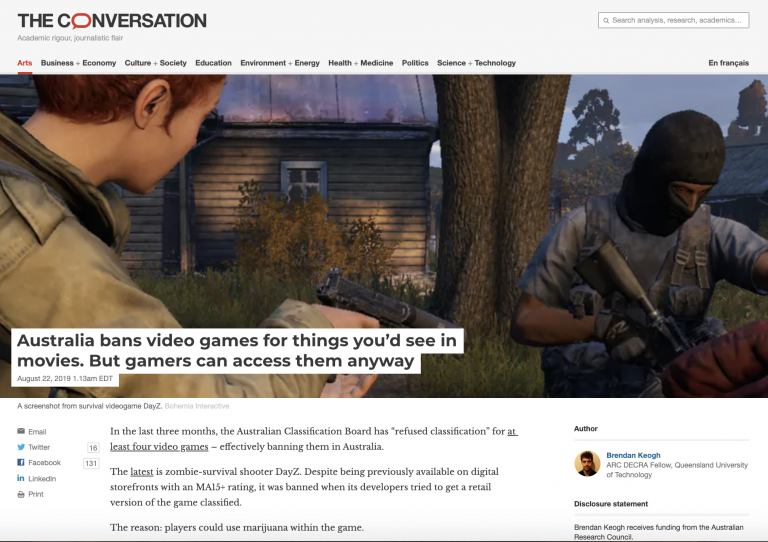
I came across some recent news that the episodic adventure game Life is Strange 2 has been temporarily removed from digital stores in Australia, as their Classification Board reviews the game’s age rating. Exploring further I found that in general, the ACB tends to be quite harsh when it comes to video game classification, with a history of refusing classification for games that are otherwise readily available in other countries; just in the last few months, they’ve banned four games, including DayZ.
This article is an interesting read; it goes a bit into the history of the ACB’s age rating system, though the developments in the 2010s don’t seem to have had much impact on how video games are treated by the Aussie classification system. That depictions of violence and drug use which would be acceptable in films are cause for banning a video game seems to perpetuate the idea that interactivity increases the impact of any violence or drug use that appears. It does seem like the ACB’s system curtails the enjoyment of video games as an artistic work. Perhaps this could be relevant to the course’s theme of “Controlling” to come up later this term.
Sorry about not being able to figure out how to get the sound from the internet up so that it was truly listenable today. It would be great if you could watch Mary Meeker’s talk from 9:13 to 17:02 on the above video. That corresponds to Slide 80 to Slide 150 on the deck just below the video. Please reflect on what you think of Ms. Meeker’s suggestion that: “Perhaps interactive gaming evolution/growth/usage with related data collection/analytics/real-time simulations and engagement has been helping prepare society for the ongoing rise of human – computer interaction?”
Be prepared to discuss in class and/or feel free to post your thoughts anytime you wish to.
I just stumbled across this article that discusses an interesting new strategy for increasing player engagement with games. The idea is to release games in smaller pieces over time. Traditionally, games are released in their entirety when they are complete. The supposed problem with this is that it makes games “disposable” and incentivizes “bingeing”, where customers buy games, play the whole thing for a short, intensive period of time, and then shelve it or throw it away. The problem EA is fighting against is the fading attention of their customers after the release of their games. Instead of releasing a whole new game to renew interest, EA is experimenting with a staggered release model with one of its games, Plants vs Zombies: Battle for Neighborville. Even though the game is fully complete, it is being released over the course of six weeks. Additionally, EA is giving an incentive to buy early through a 25% discount off the full price.
I don’t really think of releasing a full game as a problem. Numerous games have been massively successful without this kind of release structure. Having said that, to compare this to television and movies, this could open the door for another category of more casual, episodic games as opposed to trying to make every game a big, blockbuster release. It’ll be interesting to see if this kind of strategy is successful or profitable enough that it shows up in other places. Anyway, even though it’s more business-focused, I thought the article seemed relevant enough to the course to share.
GDPR was something that was mentioned several times during the last week’s lecture so I looked it up. The 3-minute-long video below by WSJ explains the regulation in a really concise manner.
Even if its headquarter is not located in a EU country, any organization that 1) carries on business in EU, 2) electronically provides goods/services to EU residents, or 3) monitors the activities of EU residents must comply with GDPR. …that seems to cover most global corporations. And as Willy mentioned last week, such corporations tend to line up their global policy with the most strict regulations out there so GDPR will likely become the new standard to which everyone will adapt.
Volume 2, Issue 1 of the Interactive Entertainment Law Review published by Edward Elgar is available. The aim of the Interactive Entertainment Law Review is to serve as a peer-reviewed hub for legal analysis of interactive entertainment, video games, virtual/augmented/mixed realities, social media, and all related and emergent forms of digital interactive entertainment. The Journal is published twice a year with articles focusing on the legal changes, challenges and controversies in this high profile and increasingly critical area of legal inquiry and is edited by Dr. Gaetano Dimita of the Centre for Commercial Law Studies Queen Mary University, Dr. Marc Mimler of Bournemouth University and myself.
Click on the image below to access the Issues webpage…
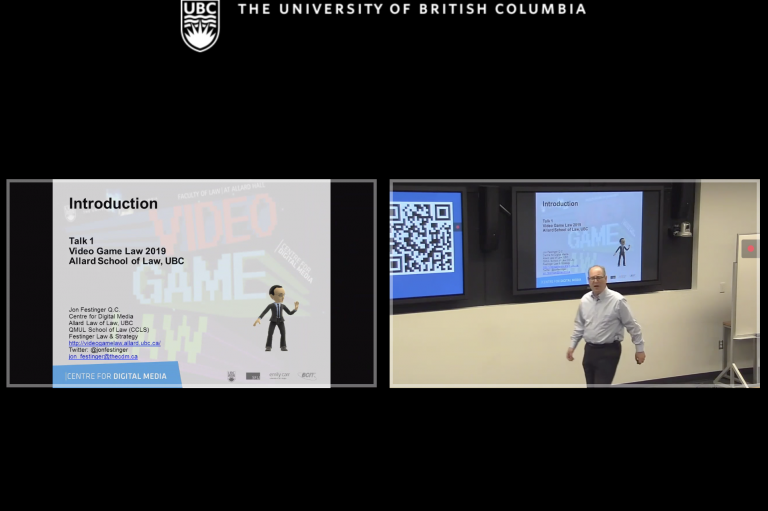
Slides and video above. Sorry that the first minute or two of Willy’s talk is not super loud. Good news is that I realized (for the first time ever) what adjustments to make, so it does get fixed early on.
In class I said I would post my first outline for a text (and perhaps also a course) on Freedom of Thought in the Digital Age. Many of the issues outlined here will show up in various forms and guises as we explore the Video Game Law course. Should you wish to share any thoughts on the subject broadly or the specifics outlined or make any suggestions, I would be excited to receive them. Click on the image to see it all.
A huge thanks to Dr. Willy Duhen of Activision for speaking to our first class of the year on the (dominant) international aspects of Video Game Law as practiced on a day to day basis.
Willy is currently Senior Manager, Legal – International with Activision Blizzard and is based in London, U.K. He is lawyer with over 10 years of experience both in-house and in government/academia working on a wide range of topics, including data protection and privacy, commercial, distribution, marketing, public policy and regulatory matters. Prior to his time at Activision Blizzard he was European Privacy Counsel – Legal for Electronic Arts. He has also been an Assistant Professor at the Aix-Marseille Law School in Paris and Aix-Marseille, France.








 Check out theVideos of Interest to Law 423 on YouTube
  Communications Law
 Join the Community!