Further to Roch’s point today in class about the patent wars by Apple, here is (another) article I wrote the IP blog out of Osgoode discussing some of the potential benefits or not to the smartphone wars.
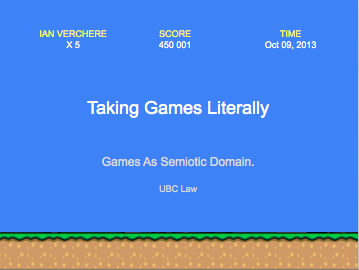
The focus of Week 5 was an amazing guest stint from Ian Verchere “Taking Games Literally: Games As Semiotic Domain”. Unfortunately Ian’s slides don’t show up in the Mediasite versions (probably because they were so video heavy). However a lite version of those slides can be found below the videos.
Now that we have traversed the “Creating” section of the course, have invited Roch Ripley of Gowlings back to provide you with alternate perspectives on the copyright law interpretations I have subjected you to 😉 The idea is to arm you with some different views as you move forward through the inevitable dialectic inherent to unraveling the paradoxes of IP law in the digital age.
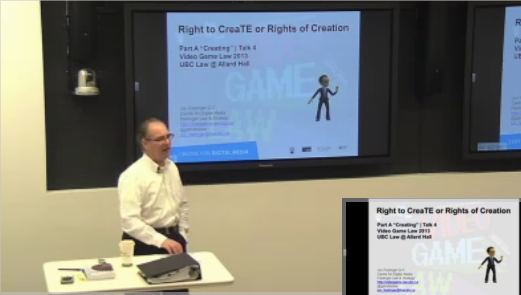
Week 4 features a wonderful talk from Greg Lastowka of Rutgers Law. Though we could see Greg’s slides in class the video-capture system cannot simultaneously access slides fed remotely and a remote video feed. So you are stuck with a second screen of me during Greg’s talk which most fortunately can simply be turned off (please). Greg’s slides are below so you can follow along courtesy of your own manual dexterity.
Note: There is currently a bit of a dead-zone between 1:00:34 & 1:04:19 as we set up for Greg, which you can painlessly skip over.
For the last couple of weeks there has been this odd and mostly (but not entirely) facetious thought running around in my brain…
Among the Edward Snowden related revelations we know the N.S.A. has downloaded tremendous amounts of data which it is storing. Though the focus has been on location data as well as metadata, it sure sounds like they are copying and storing as much as they can from the devices of persons considered to be of interest. Depending on which media report you are reading, those persons of interest might be restricted to just some foreign nationals, or just about anybody.
Among those downloaded and stored materials it seems likely that there must be a fair bit of copyright material including films and songs. Shouldn’t the music and film/TV industry sue the U.S. gov’t for intellectual property breaches on that basis? After all in the past those “copyright industries” have demonstrated a willingness to sue users who they feel have been improperly downloading. Or is surveillance fair use/fair dealing? 😉
What little I could find and follow on the statutory basis for NSA intervention, there are arguments that the process legitimately exempts government from ordinary search warrant and privacy requirements. However have not anywhere seen any suggestion that the NSA would be exempted from IP violations.
This is all cute in theory. Of course I must be missing something big and obvious here – what is it?
Had two very recent technology interactions which surprised me and brought some issues of privacy and surveillance into sharper relief. Theory is one thing. Read popular and academic articles on the subject is another. Having what viscerally feels to be an intrusive experiences, even in an admittedly small way, stirs a whole new level of reflection.
Some context. I was returning (ironically) from a symposium at Loyola Chicago on digital ethics (http://digitalethics.org/events/third-annual-international-symposium-on-digital-ethics/). The first event was paying for my cab at O’Hare Airport. Did so by credit card and the driver wanted to send me the receipt by email. Accordingly she asked me to fill out my email address electronically into the form on her “Square” device. Was happy to do so – except that my email was already there (though partially blacked by the use of ****. However the only way my email address could have been there in any form would appear to be through the agency of my credit card. Had no idea my card could give out my email address, whether directly or through the cloud (obviously don’t know what the precise technical means was). It all felt weird, mostly because it took me by surprise.
The second strange and surprising moment was coming through Customs at YVR. The line was super long so for the first time at the airport I used my Nexus card (which is quite wonderful in a great many ways). What felt odd was that I never even had to use the card except to show it to a real person on entry and exit. When I interacted with the automated Nexus system the device only asked to take a picture of my face close up (presumably a retina scan). Was really quite taken aback to see that all my information was on a form of receipt provided. What shook me is that there had never been any interaction with my Nexus ID card whatsoever. Was pretty uncomfortable in feeling that my card was transformed into a form of a ruse creating an inaccurate assumption in my own mind of at least some control over my own information. In fact that is plainly not the case.
There is little to no doubt that I must have agreed to all this in some form of a contractual document. If memory serves the Nexus documents are quite clear and foreboding, so though the interaction felt very strange that was probably really about a new form of digital interaction that I had never experienced. That my credit card somehow gives out some form of my email address to a cab driver in Chicago was not something I ever saw coming…EULA or other form of contractual agreement, or not.
So perhaps it all ends up being about context and what constitutes a surprise. Which brings us back to video-games and specifically to the Kinect. Obviously Microsoft is alive to the issues as the following article illustrates:
Ian Verchere who is co-founder and the Chief Creative of Roadhouse Interactive, a 50-person production and development company shaping the future of mobile, tablet and online games will be our guest next class. Ian will share his views of ongoing dialectic between creators and the law. Ian has a particular gift for illuminating the paradox of legal structures which constrain creativity while seeking to protect creative enterprise.
From Ian’s LinkedIn profile:
“Verchere is a creative producer, writer and visual artist. Since graduating with honors from the Emily Carr Institute of Art and Design (ECIAD) in 1989, he has been involved in the creation and production of over 30 video and computer games, including creative producer on the million-plus selling SSX Tricky and NBA Street V.2 for Electronic Arts, and designing and producing the classic, best-selling Sega Genesis title Beavis and Butt-head for MTV.
Verchere was one of the founders of Radical Entertainment, and was instrumental in growing the company into one of the world’s largest independent game developers. After serving as Studio Creative Director, he left in 1998 to join Electronic Arts (Canada) as a Producer.
In 1994, he wrote and directed The Divide: Enemies Within for Sony PlayStation. This award-winning title was recognized for its original story, and for the innovative CG short film that opened the game. In 1998, he brought the greatest action star in the world to the video game world, signing Jackie Chan to an exclusive worldwide deal.
He co-wrote Mom’s Cookies, a screenplay with Douglas Coupland that was bought by Disney, and is a member of the WGAw. As Executive Creative Director for Millions of Us, he helped MoU secure an exclusive agreement with Sony to create and develop virtual worlds and lobbies for PlayStation Home, including Sony’s own Home Lobby and Orientation Experience.
Verchere founded Roadhouse Interactive with James Hursthouse and Tarrnie Williams , and leads creative there.”



 Check out theVideos of Interest to Law 423 on YouTube
  Communications Law
 Join the Community!