
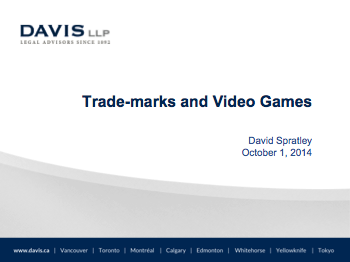
Here is a nice piece that summarizes U.S. law in the wake of Dave Spratley’s talk to us last week: Can you use other companies’ trademarks in your video game? | Zachary C. Strebeck: Attorney at Law.
jon
Here is a nice piece that summarizes U.S. law in the wake of Dave Spratley’s talk to us last week: Can you use other companies’ trademarks in your video game? | Zachary C. Strebeck: Attorney at Law.
jon
Before the course started, I had begun reading the book “Reality is Broken” by Jane McGonigal. In this book, McGonigal presents the same four necessary components of a “game” that our guest speaker, Mavis Dixon, gave during her talk today: A goal, rules, a feedback system, and voluntary participation. Both also quote Bernard Suits, who said that “Playing a game is the voluntary attempt to overcome unnecessary obstacles.”
Since reading that part of the book, I’ve been considering whether the behaviour of individual players throws a wrench into those ideas. The problem is this: if a game is defined (at least partially) by it’s rules and goals (or obstacles), does that mean that changing the rules, goals, or obstacles turn one game into an entirely different game?
Many gamers will create self-imposed obstacles, goals, or restrictions on top of a complete game. For examples of this, see this blog. “No Wrong Way to Play” was created by Anthony Burch (the writer for Borderlands 2 and the web-series “Hey Ash, Whatcha Playin’?”) to document some of the more interesting variant play styles. To use one of the examples from the site, is a person doing a low-score run of Super Mario Bros. (wherein one attempts to complete the game earning as few points as possible) really playing Super Mario Bros.? Or are they playing another game entirely?
Our discussion about post-structuralism and video games really opened up a new dimension of this for me. Since post-structuralism rejects the idea that a work has a single interpretation or purpose, would that kind of analysis resolve our problem? Could we say that the rules, goals, and obstacles presented by the game are merely one interpretation of what it means to play the game?
What do you all think?
After writing all this down, I’m starting to form connections between existentialism, The Stanley Parable, and the idea that playing a game is necessarily a critique of the game’s systems. I think I’ll leave those ideas for the comments.
This week, streaming consoles, mobile gamers, troubled trolls and a troubling politician.
jon
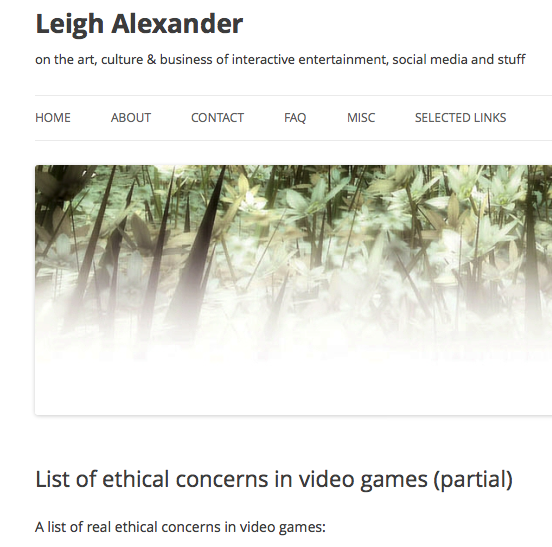
This is an extraordinarily clear and well done list of “real” ethical concerns respecting video games. Most, if not all, have significant legal implications and provide strong roots for excellent term papers.
Leigh Alexander’s terrific post can be found here: List of ethical concerns in video games (partial) | Leigh Alexander.
jon
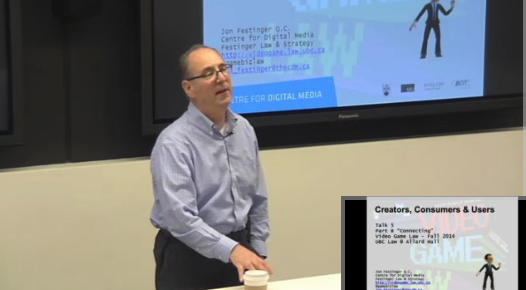
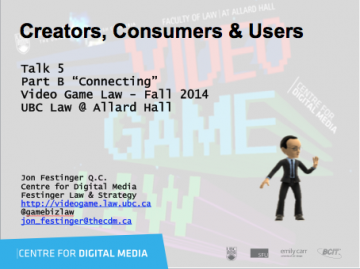
This weeks slides and videos just in case you really want to hear more about post-structuralism. 😉
Thanks again to Dave Spratley for his talk focussing on trademark law and games.
jon
I think this would be a pretty interesting thing for the class to play “spot the intellectual property issues” with, particularly as it pertains to fair dealing and the s.29.21 of the copyright act.
http://www.8bitphilosophy.com/
https://www.youtube.com/watch?v=Vz3eOb6Yl1s
How would the IP issues change if the authors looked to gain revenue for their creations, even indirectly?

Mavis Dixon is Manager of Projects and Engagement with Ayogo Health Inc. Ayogo blends game technology, patient-centered health narratives and design thinking to create games for people with chronic health conditions. A certified PM with a background in psychology, social media and marketing strategy, Mavis’s work has impacted the lives of millions of Canadians. At Ayogo, she engages patient communities and health industry partners through strategic alliances that improve adherence and health outcomes. She writes on Patient Engagement and moderates the Patient Engagement group on LinkedIn: http://www.linkedin.com/groups/Patient-Engagement-5061283/about
jon
GAMES
1. California Court Dismisses McRO Patent Claims Against Activision, Others
2. Another Open-Source Developer Claims Hyperkin is Illegally Using Code for Retro Console System
4. ESA: One-Third of Americans Play Mobile Games
5. Louisiana Tea Party Candidate Blames Atheism and Video Games for Sandy Hook Shooting
6. In Plain Sight: Rocket Internet Subsidiary Sells Pirated Games to Pakistan
7. Report: ISIS Recruiters Use Social Media and Video Games To Connect With Young People
8. Xbox Underground hackers plead guilty
9. Game Industry Myths: Women and the Game Industry
10. Why video games are so expensive to develop
11. The iPhone 6 Plus Is Great For Gamers
12. Not a joke: A Tetris movie is being made
DIGITAL
+ When Your Job Is to Moderate the Internet’s Nastiest Trolls
14. CRTC vs. Netflix: Has Canada’s Broadcast Regulator Started a Fight It Can’t Win?
+ CRTC is doomed to lose the fight it’s picked with Netflix
16. US top cop decries encryption, demands backdoors
17. Literary Lions Unite in Protest Over Amazon’s E-Book Tactics
18. Grooveshark, where employees uploaded thousands of songs, loses badly in court
19. Google and Apple Won’t Unlock Your Phone, But a Court Can Make You Do It
20. A Glum Sign for Apple in China, as Smuggled iPhones Go Begging
23. Copy-Remix-Profit: How YouTube & Shapeways Are Inventing the Future of Copyright
25. In a selfie situation, who owns the shot?
26. A Wearable Drone That Launches Off Your Wrist To Take Your Selfie
CONSTRAINTS
27. How Copyright Law Protects Art From Criticism
28. Creativity vs. Big Data? An Interview with Viktor Mayer-Schönberger
30. The Psychology of Cryptomnesia: How We Unconsciously Plagiarize Existing Ideas
32. Mark Robertson interviews F. Jay Dougherty: Authors Guild vs. Google: Fair Use or Foul Play?
33. Marvel And The Jack Kirby Estate Have Reached A Settlement
34. The Medium Is the Message, 50 Years Later
jon
I had an interesting conversation with David after our Week 5 class about nominative fair use and the movie Super-Size Me. For those of you not familiar with the film: first off, watch it because it’s hilarious. Documentary maker Morgan Spurlock spends one month eating three meals a day, only eating at McDonald’s. I’ll let you imagine the result.
My question for David was: the golden arches appeared more than in passing (so this wouldn’t be nominative fair use), and we can all be reasonably certain that McDonald’s didn’t licence anything to Spurlock for this film (if you’ve seen the movie, you’ll understand). So, how was Spurlock able to make such extensive use of this McDonald’s trademark?
After talking with David and reading a bit, I think the answer might be this: it is not trademark infringement, because a consumer is unlikely to confuse the movie as a McDonald’s product nor are they likely to believe McDonald’s sponsored the movie. It is not copyright infringement per a fair use defence, because the purpose of the film could be classified somewhat as reporting or research (terrible, terrible, immoral research 😉 ).
I’m not sure if that’s an entirely accurate answer, so maybe others can pitch in.
Interesting read particularly in the context of Mr.Dartnell’s talk a few weeks ago regarding the legal implications of game-making (licensing, rights of tattoo artists, etc.). With gaming graphics the way they are today, I only see these issues arising more often.
The article also makes reference to Lindsay Lohan, who is suing the makers of “Grand Theft Auto V” claiming a character in the game is based on her.
Jude
 Check out theVideos of Interest to Law 423 on YouTube
  Communications Law
 Join the Community!