Video and slides without incident. Thanks to Andy Moore for his provocative and thoughtful perspectives.
jon
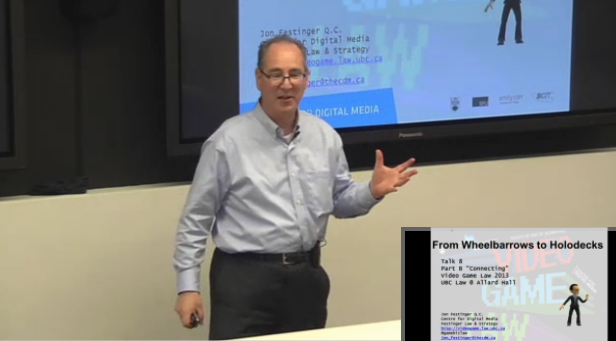

Video and slides without incident. Thanks to Andy Moore for his provocative and thoughtful perspectives.
jon
This week EULA’s, citizens and double standards of literalism.
jon
As I understand, EULAs and TOS are a type of adhesionary contracts. The Legal Information Institute at Cornell University defines an adhesionary contract as “a standard form contract drafted by one party (usually a business with stronger bargaining power) and signed by the weaker party (usually a consumer in need of goods or services), who must adhere to the contract and therefore does not have the power to negotiate or modify the terms of the contract.” This sounds just like EULAs and TOSs. They are written by one party, the video game developer, and signed by the weaker party, the gamer, who must adhere to the contract if they want to play the game and has no option of modifying the terms.
Adhesionary contracts are also used outside of video games. If you’ve ever bought car insurance, travel insurance, or any other type of insurance, you’ve almost certainly signed an adhesionary contract as their us is standard practice in the insurance world. As I’ve learned in Insurance Law, because of the one sided nature of adhesionary contracts, Courts interpret any ambiguity in such contracts against the author (also known as contra proferentem) as it was solely in the authors power to avoid the ambiguity when the contract was drafted.
Therefore, one would think that courts would also interpret EULAs and TOSs against game developers and in favour of gamers, but, if I remember Professor Festinger’s earlier lectures correctly, this is not typically the case. Why do you think this is? Just like between an insurer and an insured, there exists a large power imbalance between game developer and gamer, and yet developers seem to have EULAs and TOSs interpreted in their favour.
Perhaps the disparity is because of what the adhesionary contract provides. For gamers, the adhesionary contract provides pleasure, whereas for the insured, the adhesionary contract provides peace of mind. Therefore, it is possible that the court places greater importance in peace of mind than in pleasure, but should they? After all, when it comes down to it, is peace of mind really that different from pleasure?
 We are particularly privileged this coming week to have as our guest Jennifer Lloyd Kelly. Ms. Kelly is IMHO the leading video game law litigator in the world. She is (for the second time in the history of the course) making the trek from San Francisco where she practices at Fenwick & West LLP. The adjacent photo illustrates Jennifer’s love of ski towns which at least in part explains her willingness to come up to B.C. to speak to us about legal aspects of “originality” in video games.
Jennifer’s Linked In summary says it all:
“I am a partner in the IP and Technology Litigation Group at Fenwick & West and have been in practice for 17 years. I work primarily with companies in the technology sector, including software, gaming, social media, and Internet. My practice focuses on resolving disputes both in and out of court, with a particular emphasis on copyright, trademark, trade secret, false advertising, unfair competition, and defamation disputes, and I pride myself on winning or resolving them early. I was recently named by the Daily Journal as one of the “Top Intellectual Property Attorneys of 2014.”
A large part of my practice, and my passion, is working with clients in the video game/mobile app sector. I not only defend companies who are accused of infringing the copyright and other intellectual property in other’s games, but regularly counsel game clients during the product development phase, providing advice about how to design games/apps to avoid claims for infringement. I also represent companies whose games have been knocked off, including in a recent copyright infringement case I brought on behalf of King.com (publisher of Candy Crush Saga), in which I obtained a very favorable settlement for King that included a stipulated injunction permanently enjoining distribution of the infringing games as well as a substantial payment by their publisher, 6waves.
I regularly author articles and lecture on intellectual property issues in games/mobile apps, including at Berkeley Law, the University of British Columbia Law School, the Gamer Technology Law Conference in Seattle, and the Game Business and Legal Affairs Conference at UCLA.
Specialties: Industries: technology, software, video gaming, mobile gaming, social media, Internet
Practice: intellectual property litigation, commercial litigation, business litigation, copyright, trademark, trade secret misappropriation, false advertising, unfair competition, defamation, libel”
jon
My immediate reaction when this question was asked last week and this week was “because law is slow to change in relation to most things.” For example, last Friday (the 18th) was Persons Day, the 85th anniversary of the Persons Case. Sure took a while for that (now obvious and self-evident to most, I hope) decision to be made, and it had to go all the way to the Privy Council. There’s the old magical assertion of Crown sovereignty and the fact that aboriginal title has just been officially found by the courts this summer in Tsilhquot’in, despite it having been there all along. Human rights and the introduction of the Charter just 32 years ago. Animal rights – still waiting on that one, but with incremental signs of recognition and improvement (for example, a beautiful dissent in the 2011 Lucy the Elephant case Reese v City of Edmonton, and today’s dissent can always be tomorrow’s majority!). In the communication slides from today’s class, I saw hope for the new paradigm that could come with the age of virtual reality. For example, at the Animal Law Conference in Portland this weekend we learned about the use of technology, including computers and VR, and individualized cellular testing – both in lieu of animals – for greatly improved testing of medical procedures, drugs, and toxins. As technology continues to develop, I am hopeful that the incremental changes that will follow in the law will improve the circumstances for everyone, from gamer/creator/connectors to non-human animals. (Also, speaking of Portland, there is an amazing bar there called Ground Kontrol which has two storeys full of arcade games (pic below) – highly recommended! (http://groundkontrol.com/)
GAMES
+ ESA: “There’s no place in the video game community for threats”
+ So Long #Gamergate. What Did You Teach Us?
+ On GamerGate: A letter from the editor
+ Rape and death threats are terrorizing female gamers. Why haven’t men in tech spoken out? (Brianna Wu)
+ More women play video games than boys, and other surprising facts lost in the mess of Gamergate
+ The Future Of The Culture Wars Is Here, And It’s Gamergate
3. ‘Hatred’ Unapologetically Embraces The Violence of ‘Mass Killings’
+ ‘Hatred’ Developer Creative Destruction Denies Accusations That Some Studio Members Are ‘Neo Nazis’
4. Nintendo Bricks Wii U Consoles Unless Owners Agree To New EULA
+ Virtual worlds players – consumers or citizens?
5. Multiplayer Network Innovations Files 26 Patent Infringement Lawsuits Between August and October
+ Mike Maulbeck Resigns From Code Avarice
7. Counter-Strike: Global Offensive team accused of match fixing
8. Digital Extremes sells 61 per cent of shares for $73 million
9. Sony launching eSports league
10. 40,000 fans pack stadium for League of Legends final
11. FGC Player Terrance ‘PushaTee88’ Moore Passes Away After Collapsing at Tournament
12. How Palmer Luckey Created Oculus Rift
13. Action Video Games Improve Sensorimotor Skills
14. One year after launch, The Stanley Parable surpasses 1M sold
15. Report: Mobile to become gaming’s biggest market by 2015
DIGITAL
16. BBC to publish ‘right to be forgotten’ removals list
18. Parents May Be Liable for What Their Kids Post on Facebook, Court Rules
19. UK stiffens maximum sentence for online harassment to 2 years
20. Amazon’s Monopsony Is Not O.K.
+ Amazon Must Be Stopped: It’s too big. It’s cannibalizing the economy. It’s time for a radical plan.
+ Amazon’s Elite Reviewing Club Sabotaged My Book
22. China Turns From ‘Pirate’ Nation To Giant Patent Troll
23. How Corporate Canada Rejected the Canadian Government’s Plan to Combat Patent Trolls (Michael Geist)
26. Revealed: how Whisper app tracks ‘anonymous’ users
27. Facebook wants the DEA to promise that it won’t create fake accounts
28. Explaing the rise and fall of the Warez MP3 scene: An empirical account from the inside
29. Illegal Copying Has Always Created Jobs, Growth, And Prosperity
30. Human society in a digital world – by Neelie Kroes and Carl-Christian Buhr
31. Virtual Economies – what can they teach us about the real world?
32. Lobster Is A Marketplace For Licensing Affordable User-Generated Content
CONSTRAINTS
33. Crooner in Rights Spat: Are copyright laws too strict?
34. What has happened to journalism?: Redeeming an institution that is essential to democracy
36. HBO has embraced Netflix’s business model, but not its net neutrality politics
37. Comcast “extortion” shows the need to treat broadband as a utility, Reddit’s Ohanian said
38. Will Silicon Valley Buy Hollywood?
jon
This week the connections between cognitive dissonance, journalism and murderous misogyny.
jon
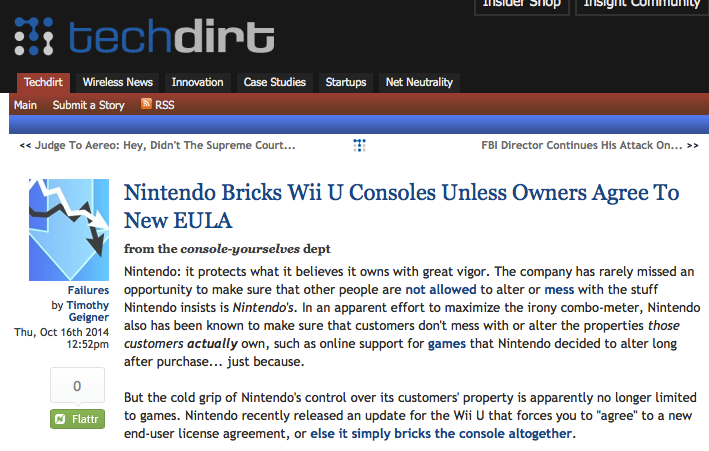
Check out this story from techdirt:
Nintendo Bricks Wii U Consoles Unless Owners Agree To New EULA
Thanks to Nintendo for their spectacular though inadvertent timing in supporting our course curriculum. Many of the arguments against contractual overreaching through EULA’s and ToS’ which we have explored over the last couple of weeks seem to find resonance here. Is Nintendo courting a class action suit? What is the appropriate recourse against Nintendo for a gamer if they don’t want to agree and whose hardware has been impacted as a result? What might be the potential remedies here? What causes of action do you see in tort? In contract? Anything else?
Thoughts/reactions/suggestions?
jon
Thanks to Don McGowan of The Pokemon Company for coming up from Seattle and braving a very long wait getting through the tunnel on his way back.
The fears around whether Don was mic’d or no proved somewhat exaggerated, though not completely so. The microphone worked fine through most of Don’s talk but then turned off (batteries died?). Fortunately because of the strength of Don’s voice (he does professional audio work) and the secondary microphone in the room, he is audible throughout – though there will be a point where you might want to turn up your speakers a bit.
Video and slides follow.
jon
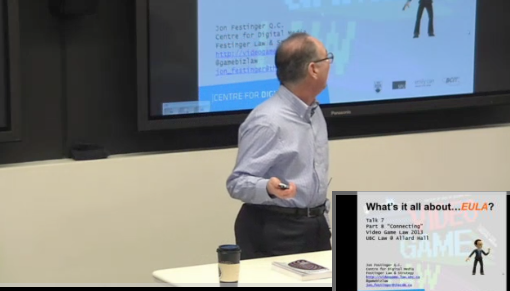
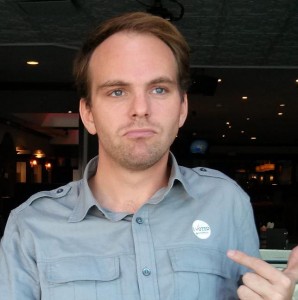
Andy Moore will be joining us as next week to talk about the future of games, the games industry and the role of “indy developers”.
Andy is a programmer by trade (but a teacher at heart), and has helped game studios and other digital-media companies as a consultant, contractor, and specialist; focusing in the fields of rapid development, prototyping, data collection & analysis, and the “lean startup” pivot-style project management. He developed productivity-applications for ten years before going all-in on independent video game creation in 2008, opening his studio Radial Games. Within a year he produced the SteamBirds franchise, an award-winning free-to-play turn-based strategy game; and subsequently launched the critically acclaimed title Monster Loves You! on Steam. Currently, Andy is working on future games for the Steam and mobile platforms. His most recent game is (the quite wonderful) ROCKETSROCKETSROCKETS (http://rocketsrocketsrockets.com)
jon
 Check out theVideos of Interest to Law 423 on YouTube
  Communications Law
 Join the Community!