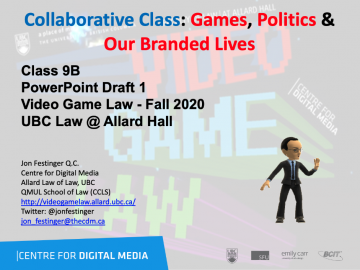
Here are the slides from our collaborative class. Have also put the original video below for convenience. Though hopefully the slides can stand on their own a starting point for your own version/feedback/branching narrative…

Jon
Here are the slides from our collaborative class. Have also put the original video below for convenience. Though hopefully the slides can stand on their own a starting point for your own version/feedback/branching narrative…
Jon
Video and slides from our November 18 class below…


Jon
Hi everyone!
Here is my term project on the effectiveness of copyright law – enjoy!
Some background:
A while back we discussed Jessica Silbey’s book The Eureka Method and her finding that current copyright law does not really reflect how artists work.
When reading her book, I found that it focused heavily on artists who were intrinsically motivated to create. They created art because they loved doing it or because they loved being in creative environments.
The cynic in me wondered if the reason that copyright law didn’t reflect how Silbey’s interviewees really worked was because it was created for people who are motivated by the ability to make money off of their work.
To explore this further, I interviewed Julian Ing, the founder of Vancouver-based social gaming company, Eruptive Games (which has since been sold). I knew that Julian had started the company, not because he was passionate about creating games, but because he saw an opportunity to make money. I wanted to know if copyright law had complimented his process of building a creative company, or if he too experienced a disconnect between the law and the creative process.
This endeavour also gave me some insight into the nature Canadian copyright law in particular.
If you’re curious about my findings, you can find my project attached here: Jessica’s Presentation
Other Links:
Hyperlinked are the intro of Jessica Silbey’s book and the video from my interview with Julian to give my presentation some more context
If you have any issues with the links please let me know via Teams.
Thanks for tuning in!
GAMES
DIGITAL
A.I.
COMMUNICATIONS
INTELLECTUAL PROPERTY
PRIVACY
CREATIVITY
Jon
Hi everyone,
I hope you were able to enjoy your reading break!
On Wednesday, I will presenting on Black Mirror: Bandersnatch, the interactive film.
Prior to the presentation (if you have the time) kindly watch/ play the film. It can be found on Netflix. Please let me know via teams if you have any access issues.
In this post I have also included a short clip, which is optimal for viewing after you have watched the film.
See you Wednesday,
Dinah
GAMES
DIGITAL
A.I.
COMMUNICATIONS
INTELLECTUAL PROPERTY
PRIVACY
CREATIVITY
Jon
Hello everyone! On Wednesday, November 18th, Jared Knott and I will be presenting on the scourge of cheating in competitive multiplayer games, and legal responses to those cheaters. The problem of cheating has only gotten worse in the past few years, with most of the largest multiplayer titles having some issue with wallhacks, aimbots, macros, and much more. This has led to the development of innovative anti-cheat strategies, and lawsuits directed at both cheat-makers and the players themselves.
In order to make the presentation a little more fun and interactive, we have structured it as a (very, very simple) choose your own adventure game! Please feel free to download the presentation from this link, start it up, and click your way though to learn a bit more about the kinds of cheats in the market, and how developers/publishers are reacting. If you are just interested in the information, a PDF is also available at the link. We look forward to chatting with you on Wednesday!
Feel free to post any questions or observations you might have on this post, as we would be more than happy to chat. Also, please let us know if there are any issues with the download.
 Revisiting how video games affect the world, I was brought back to the use of video games by scientists to generate data and data analysis. One of my first personal encounters was Project Discovery in EVE Online.
Developed and published by CCP Games, EVE Online is a Massive Multiplayer Online Role-Playing Game (MMORPG). CCP Games worked in collaboration with Massively Multiplayer Online Science (MMOS), Reykjavik University, and various other real-life universities to create a series of minigames called Project Discovery. The series introduces real-life science data problems for gamers to look at and say “what this looks like”.
In 2016, I personally got to play Phase One of Project Discovery, Project Discovery: Human Protein Atlas, which was created in collaboration with the Human Protein Atlas (PA). It was basically an identification game where you are given images of cells and you are asked to identify what organelle (i.e. the organs of cells) was dyed green in the image.
In 2017, EVE Online worked in collaboration with the University of Geneva to create Phase Two of Project Discovery: Exoplanets. One of the ways astrophysicists identify the existence of planets outside of our Solar System (i.e. “exoplanets”) is that by measuring the luminosity of stars over time. If when and the luminosity dips, that’s a sign that an exoplanet has gotten in the way of the star’s light. EVE Online players are given luminosity graphs to identify the presence of an exoplanet at a given time.
Most recently this summer, Phase Three of Project Discover, Project Discovery: Flow Cytometry, was created in collaboration with many medical research institutions including Canada’s own BC Cancer Foundation and McGill University. This project was created for advancing research on the COVID-19 virus. Cells passed through and analyzed by a flow cytometer produces a graph and cells of the same type tend to stay together on the graph; players are asked to distinguish groups of cells from each other by putting boundaries between groups of cells on the graph.
Beyond just Project Discovery, EVE Online has been a hot subject for observation and analysis by economists because all of its players are on the same server (except for Chinese players) and its economy is almost completely player-driven safe for a few basic items like very basic ships and ammunition. I wanted to share this with the class because I think it’s very interesting and projects such as these show how video games can be more than “mere entertainment”.
GAMES
DIGITAL
A.I.
COMMUNICATIONS
INTELLECTUAL PROPERTY
PRIVACY
CREATIVITY
Jon
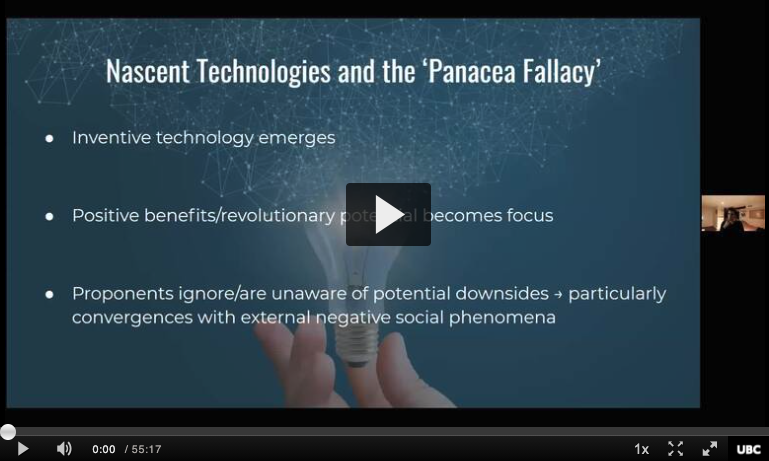
 Check out theVideos of Interest to Law 423 on YouTube
  Communications Law
 Join the Community!