Hi everyone, below is Amelia and I’s video presentation on Video Game Streamers and Music Licensing. Enjoy, and comment below if you have any questions!
 Check out theVideos of Interest to Law 423 on YouTube
  Communications Law
 Join the Community!
Hi everyone, below is Amelia and I’s video presentation on Video Game Streamers and Music Licensing. Enjoy, and comment below if you have any questions!
Video & slides below…
Jon
Hi everyone,
I came across a bit of video game news that I found to be quite interesting—especially following the recent presentations that we’ve seen on the “video-gamification” of the world. On December 1, it was announced that we can now purchase “the world’s first video game to be custom designed for a children’s hospital” for Nintendo Switch: a game called “Castle on The Coast”. In this game, you can play as the mascot of California’s Valley Children’s Hospital, George the Giraffe, and explore, well, a castle on the coast. While this might be the first video game to be designed for a children’s hospital, it is far from the first video game to incorporate hospital or medical elements. For instance, Castle on The Coast is predated by games like “Theme Hospital”, “Rex Ronan: Experimental Surgeon”, “Medic: Pacific War”, “Hospital Tycoon”, and “Surgeon Simulator”.
This seems to be part of a broader movement towards the video-gamification of the healthcare field. This can be seen in both the increasing availability of video games in both training medical professionals, and in the increasing use of video games as therapeutic treatment.
In November of this year it was announced that a VR “surgical planning tool” has received FDA approval in the United States. The technology, which is far from the first use of virtual reality in medicine, can create a 3D version of a CT scan, whereupon a surgeon may use VR to focus on specific regions prior to surgery. There is also evidence that surgeons who play video games may be better at performing some procedures (such as laparoscopic surgery—which arguably involves a screen and a console to begin with?) than their more solemn counterparts.
The use of videogames in treatment is also increasing. For instance, one study found there is evidence that video games can help improve arm and hand function in people affected by cerebral palsy. Another study found that videogames might be a viable treatment to offer people with Parkinson’s disease in order to improve their balance. Videogames may offer preventative benefits as well, whether it’s in encouraging a healthy lifestyle, or in detecting depression.
Some suggest that the virtual healthcare experience will be facing many new changes in the years to come. In an article for Politico, one doctor said that “he is optimistic about the patient’s experience in the metaverse, where users may be able to drop into clinics, hospitals or research experiments in a way they can’t through today’s mental health apps”.
Hi everyone,
Here is the presentation video Simran and I (Amy) put together for the class. We discuss Canadian and US considerations of freedom of expression, and its intersection with Avatar creations. Possible exploitative directions sophisticated Avatar customization in video games are explored, and possible protections individuals may have against such exploitation are suggested.
We hope you enjoy the video and our discussion. If there are any questions, feel free to comment below or email me at amyko90@gmail.com.
Thank you!
Video & slides below…


Jon
Hey all,
I came across this interesting article about how Disney, who owns ESPN, is planning to move into the sports betting space. This is something that Disney had previously avoided to safeguard its family-friendly brand, but new CEO Bob Chapek has opened the doors to the possibility. As the article notes, a key reason for this shift is due to changing consumer attitudes around gambling, which is something that we’ve seen developing in the video game space for some time. The article also notes that increasing gamification of media is encouraging the move:
We have done substantial research in terms of the impact not only on the ESPN brand, but the Disney brand in terms of consumers’ changing perceptions of the acceptability of gambling. And what we’re finding is that there is very significant insulation,” Chapek said. “It actually strengthens the brand of ESPN when you have a betting component, and it has no impact on the Disney brand.”
So what changed? Changing consumer habits is one piece of the puzzle, with “gamification” becoming commonplace in apps and media. ESPN+, like other streaming services, is all but certain to add gamification functionality in the future as it seeks to grow engagement and its subscriber base.
It’s interesting to see how trends that have been developing in the video game space are influencing more traditional media companies, and this trend is likely only to grow in the coming years.
Hollywood Reporter: Disney Shows Its Cards in Pursuit of Sports Betting Dollars
Hi everyone,
Here are some articles you can take a look at prior to our presentation this coming Wednesday:
Warcraft 3 Reforged EULA gives Blizzard total ownership of all custom games
What a YouTube Copyright Strike From 2015 Has to do With ‘Mario Maker 2’ in 2019
How Nintendo has Consistently Tried to Kill Competitive Smash
In a Twist, Nintendo is Actually Supporting Smash Bros
Rockstar Clarifies Stance on Modding
Rockstar EULA (Only read paragraph on User Generated Content)
Bethesda “Skyrim Creation Club” EULA (Only Restriction on Use Section)
Take Two Files Lawsuit Against Modders
Background Information (Article Helped Inspire the Topic)
Video and slides below…



Jon
I came across this article and thought it would be interesting to share. With the anonymity of video games, like that of social media comes recruitment. We have seen terrorist groups connect and grow anonymously online, recruiting people who are in mutual threads and have the same “goals” or “passions” as them. We have also seen people become radicalized by these platforms.
This article details how Drug Cartels are using video games as a way to recruit children. Reading this made me wonder how many other kids or video game users are being recruited to cartels, terrorist organizations etc. Does the attachment that you may feel with your peers over a video game increase the likelihood of a person being recruited or radicalized, especially when money is involved like in the article above. I would love to hear your thoughts on this topic!
https://www.bloomberg.com/news/articles/2021-10-20/drug-cartels-are-enlisting-kids-through-video-games-mexico-says
My presentation is on Netflix’s Black Mirror episode Playtest (season 3 episode 2), a haunting portrayal of augmented reality gone wrong. If you have not seen this episode, I would highly recommend watching it. Playtest touches on many of the issues relevant to concepts discussed in our video game law class and raises questions about our fears and morals surrounding virtual/augmented reality. My analysis of Playtest will focus on the philosophical underpinnings of these legal issues.
Note: While I recommend watching the episode in its entirety, this spoiler-laden synopsis video summarizing the key points will be sufficient to understanding my analysis below.
Synopsis video: https://www.youtube.com/watch?v=7MtRXgL7_98
Playtest demonstrates a scenario where privacy is invaded to the extreme. The playtest in Cooper’s mind took his personal data to concoct his personal nightmare, demonstrating a situation where technology uses personal data against the person.
Cooper’s experience was created and personalized based on personal data extracted by the software. This is ironic considering how Netflix is famous for similarly collecting user data to deliver personalized viewing suggestions and to create original content. This suggests that just as technology is capable of generating desirable content, it is similarly capable of doing the opposite.

Cooper at the Seitogemu AR testing room. Note the use of wide and symmetrical camera angle, the greyscale neutral colors and the square shapes and straight lines, suggesting objectivity and lack of personality.
Fear is a major theme throughout Playtest. Seitogemu is famous for making horror games. There are also many mentions of confronting the player’s deepest personal fears. If the alternate endings are in fact reflective of Cooper’s fears, then we can surmise that Cooper is fearful of the effects of Alzheimer’s (and as we know, Cooper’s dad passed away from Alzheimer’s). In one ending, Cooper forgets who he is. In another ending, Cooper returns home only to find his mother unable to recognize him. More broadly, the theme of making/losing memories and making/losing (grip of) reality is a theme throughout Playtest.
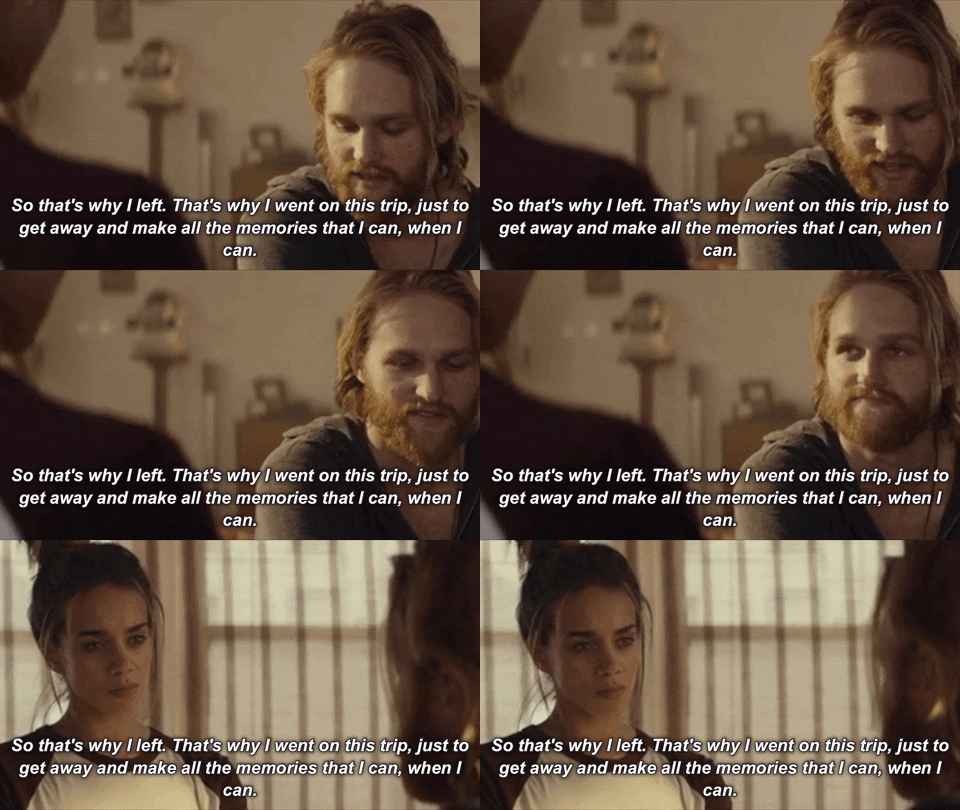
Law can be thought of as keeping collective fears in check. Societies make rules to regulate behaviors which the community deems to be undesirable or a threat. We as a society have yet to decide on how to regulate the unexplored terrain of virtual/augmented reality. Part of this begs the question: what is the subject of regulation? What is undesirable/a threat? What are we afraid will happen if virtual/augmented reality is unregulated? Playtest suggests that we are afraid of the amalgamation of virtual reality with actual reality. In Cooper’s imagined virtual reality playtest, the virtual reality projections gradually became increasingly integrated untilhe could no longer distinguish between the virtual and the real.

Cooper in the AR game site on the left, compared with Cooper in his childhood home. Note the visual similarities in architecture/set and camera angle and shot.
The state of nature political theory may help explain law’s relationship to fear. The state of nature theory is explored in the philosophies of Hobbes, Locke, and Rousseau, who are proponents of social-contract theories. Although philosophers vary in their view of the state of nature, in short, the state of nature can be described as the lack of government, where every person is looking out for themselves. For Hobbes, the only laws that exist in the state of nature are principles based on self-preservation. The lack of authority and certainty breeds fear and mistrust. The creation of government occurs when individuals transfer their natural rights to what Hobbes calls Leviathan – a sovereign, government or authority – in exchange for certainty and protection.
In their book Laws of Fear, Cass Sunstein discusses the connection between fear and law and policy. Sunstein proposes that governments aspire to be “deliberative democracies,” meaning that they are accountable to the public but also reflective and reason giving. In deliberate democracies, responsiveness to public fear is a must. Secondly, well-functioning democracies attempt to achieve “incompletely theorized agreements,” which mean that they search for what can be agreed on by diverse, heterogeneous citizens rather than commit the entire state to a controversial opinion.
According to Sunstein, this approach should be used when handling public fear by avoiding fundamental issues which the population cannot agree on:
In a slogan: Well-functioning societies make it possible for people to achieve agreement when agreement is necessary, and unnecessary for them to achieve agreement when agreement is impossible.
The point has special relevance to the question of how to handle public fear. Sometimes that question is thought to require government to resolve large problems about its basic mission – to think deeply, for example, about the nature and meaning of human life. When people disagree about how to handle risks associated with genetic modification of food, or terrorism, or pesticides, or global warming, it is partly because of differences about the facts; but it is also because of differences about fundamental issues. To the extent possible, I suggest that those fundamental issues should be avoided. Deliberative democracies do best if they abstract from the largest questions and try to obtain a consensus from people who disagree on, or are unsure about, how to resolve those questions. In the context of fear, I suggest, it is often possible to obtain just such a consensus. (p 2-3)
The many uncertainty in the developing field of augmented and virtual reality may raise public fear. If we apply Sunstein’s approach to the regulation of augmented/virtual reality, then contentious fundamental issues at the root of such fear should be bypassed.
The Inception like composition of Playtest raises the question: what is reality? What Cooper thought was real in fact took place inside his imagination in 0.04 seconds. Similarly, how can we, the viewer, know that what we experience is the ‘true’ reality if such a thing even exists?
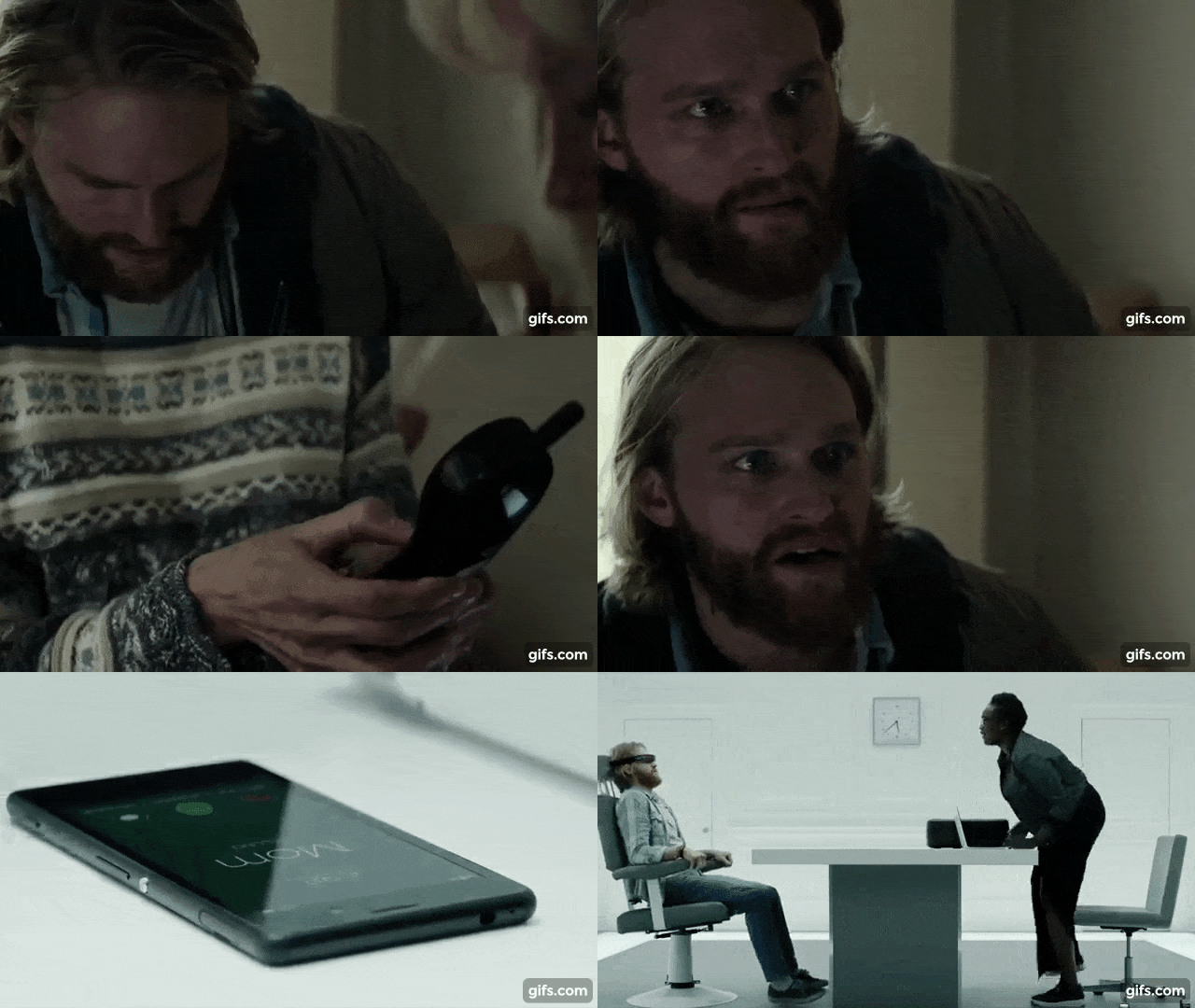
How can a player or consumer of games utilizing virtual/augmented reality distinguish between ‘raw’ reality and augmented reality? Where should we draw the line in what counts as augmented reality? A person wearing corrective glasses technically has their vision augmented; how is this different from wearing augmented reality glasses? One argument is that for augmented reality glasses, only the wearer is able to see the augmentation. However, would multiple people wearing augmented reality glasses and seeing the same augmentation make the augmentation more real?
Even if augmented reality is thought of as a layer on top of ‘raw’ reality, such regulation is a novel problem which our legal system is ill-prepared for. Many questions arise; for instance, should the virtual be treated as a separate jurisdiction? The common law is also preoccupied with identifying and formalizing facts. Would occurrences in virtual reality be treated as facts if it is only real to the user?
If, as Playtest suggests, we are afraid of the amalgamation of virtual reality with actual reality, then it would make sense to regulate in such a way as to prevent that. However, the personalization of the augmented reality experience not only makes this difficult but also raises deeper philosophical questions. Perhaps the unregulatable aspects of virtual reality and the questions it raises are merely a proxy for our own existential fears and our failure to control them.
Black Mirror’s “Playtest” (season 3 episode 2), available on Netflix.
Munro, André. “state of nature”. Encyclopedia Britannica, 23 Jul. 2021, https://www.britannica.com/topic/state-of-nature-political-theory. Accessed 14 November 2021.
Sunstein, Cass R. “Introduction” in Laws of Fear: Beyond the Precautionary Principle, The Seeley Lectures, ed (Cambridge: Cambridge University Press, 2005) 1. https://www.cambridge.org/core/books/laws-of-fear/16124E83F371BEAA5082AB07EA892836