Posts

Bitcoin currency valuation through the roof

Glad to be the first to post this.  The headline is that a man who purchased $27 of bitcoin peer-to-peer digital currency in 2009 and forgot about it discovered that it’s now worth $886 000.

Also, cheers to Vancouver for having the world’s first bitcoin ATM (link in article).  There are lots of fascinating implications to this development, although it seems a little volatile for a reliable store of value at the moment.  I also wonder how long it can stay peer-to-peer if it really takes off, especially with concerns about money laundering.

Scandinavia, Switzerland & Nollywood

In last week’s class there was an interesting though brief discussion around the possible correlation between weak IP countries and strong creative presence. This grew out of an article written by the Law Librarian at Rutgers last year which pointed out a correlation between strong economies and weak IP laws. What I wished for in that correlation was that “civil society” concepts could also be in the mix Which led me to suggest that some Scandinavian countries had perhaps achieved all three things (strong economy, civil society, and more liberal IP laws. Then Roch Ripley point out two classes ago that Switzerland had one of the world’s strongest economies last year and very strong IP laws. Leading to my rebuttal that generally speaking the creative content industries did not play a significant role in Switzerland’s economy.

Which leads us back around to the attached discussion involving Aimee Corrigan and Colin Maclay at the Berkman Centre last week. It is on “The New Nollywood”, Nigeria’s vibrant film industry. There are various allusions in it to possible correlations between weak IP laws (problematic as piracy is rampant, and a mixed blessing in other ways) and a unusually strong creative base.An interesting discussion of this can be found beginning at 39:50 as well as in a few other places.

Again, in all of this never lose sight of the fact that correlation is not causation.

jon

Week 8 Guest Speaker – Jennifer Kelly

jenniferkelly

Our guest this week is one of foremost litigators of video game related cases. Jennifer Kelly is at Fenwick & West in San Francisco. She will be speaking to us about imitation, originality and genres in games..

From Jennifer’s Linked In profile:

“I am a partner in the Intellectual Property and Technology Litigation Group at Fenwick & West and have been in practice for 15 years. I work primarily with companies in the technology sector, including software, gaming, social media, and Internet. My practice focuses on resolving disputes both in and out of court, with a particular emphasis on copyright, trademark, trade secret, false advertising, unfair competition, and defamation disputes.

A large part of my practice, and my passion, is working with clients in the video game/mobile app sector. I not only defend companies who are accused of infringing the copyright and other intellectual property in other’s games, but regularly counsel game clients during the product development phase, providing advice about how to design games/apps to avoid claims for infringement.

In 2008 I successfully defended video game company Capcom against claims brought by the owner of the rights in the 1979 zombie horror film Dawn of the Dead, who alleged that Capcom’s Dead Rising video game infringed its copyrights and trademarks in the film. The victory (a dismissal of all claims, with prejudice, on an initial motion to dismiss) cleared the path for Dead Rising 2, which was released in 2010.”

Jennifer’s latest case was the successful representation of Sega and Electronic Arts as defendants in a lawsuit brought by an artist who contributed content to some “sonic the Hedgehog” comic books. For more see: Fenwick & West Achieves Ninth Circuit Victory For Sega and Electronic Arts

jon

Week 7 – 10/23/13: “What’s it all about…Beta?” & Anoop Desai

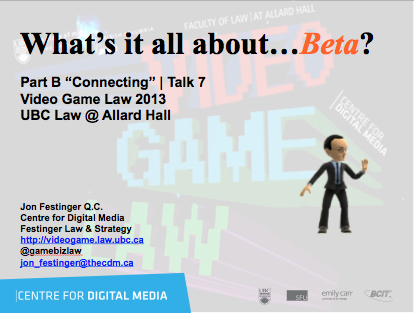
The video of Anoop’s great guest appearance is not included, but his slides (& mine) are available below.

Screen Shot 2013-10-31 at 2.17.36 PM


Screen Shot 2013-10-25 at 10.26.25 AM

Screen Shot 2013-10-25 at 10.23.08 AM


jon

3D printing and IP

This article by Deven Desai & Gerard Magliocca gives a good overview of the ramifications of 3D printing for all three areas of IP (copyright, patent and trademark).

http://papers.ssrn.com/sol3/papers.cfm?abstract_id=2338067

I agree with the characterization of 3D printing as a continuation of the digitization of commodities that began with music and video files by extending it to tangible objects, and therefore to products that are usually the subject of patent law rather than copyright.  It brings with it many of the same issues and it will be interesting to see if industry leaders take the same approaches to dealing with it.

However, I have some reservations about the author’s position that branding will become more important as patent rights become more difficult to enforce.  The author seems to think that once anyone can acquire the blueprints for a particular product (and patent disclosure rules seem to make this a certainty) the designer will still be able to market their product based on recognized quality, including safety testing and quality of materials, etc.

It seems to me that once 3D printers are a common household item, consumers will have individual control over the quality of ingredients, just like they can choose the quality of gas they put in their car.  Brands may be significant in terms of ensuring quality of design, but once the blueprints become the subject of file-sharing, consumers can take advantage of this quality without compensating the designer.  Of course, some consumers will no doubt still be willing to pay for the “real thing,” especially where status symbols like iphones and designer clothes are concerned, but 3D printing will no doubt make it easier to fake a trademark as well.  I therefore don’t see branding as a satisfactory solution to 3D printing & patent issues.

It’s also interesting to think about how patent differs from copyright and what that means for file sharing – specifically that filing for patent rights requires disclosure of the design, which might facilitate patent infringement on a grand scale once 3D printing is popularized.  If the disclosure requirement suddenly becomes a disincentive to the filing of new patents due to the ease of home-manufacturing engendered by 3D printing, industry will have a strong case for legislative reform.

As for copyright, we know it can apply to 3D copies of 2D expressions of ideas based on the famous Popeye-doll case, which would seem to make printing 3D copies from plans a protected right under copyright law.  The authors speculate that if the plan is simply a scan of a 3D object, it will likely not pass the originality test, but otherwise will be covered by the existing copyright regime.  I understand this to mean that where the scanned item is already itself copyrighted, the person who makes the scan wouldn’t have copyright in the plans they produce, but the original designer would still have rights of reproduction in their Lego block or whatever it is.  Existing copyright legislation can probably address issues such as whether making or distributing the scan is infringement or just printing from the scan, etc.

Finally, none of this is merely hypothetical and I find it exciting that we will get to watch this unfold!

 

News of the Week; October 23, 2013

1. Blizzard wins $7M judgment in World of Warcraft bot lawsuit 

2. “The Legal Status of Video Games: Comparative Analysis in National Approaches” by Andy Ramos, Anxo Rodriguez, Tim Meng, Stan Abrams and Laura Lopez (WIPO) 

3. Gaming adds $2.3 billion to Canada’s GDP 

+ Canada’s Video Game Industry in 2013 (Nordicity Report) 

4. British Newspaper Confuses Deus Ex With Real Life 

5. Illinois State’s Attorney Pushes for ‘Economic Boycott’ of GTA V

6. Dr. Kimberly Voll on Challenging Gender Stereotypes in Gaming 

7. Free will is overrated: the surreal, self-aware joy of ‘The Stanley Parable’ 

8. YouTube Personality TotalBiscuit Claims ‘ Day One: Garry’s Incident’ Dev Made Copyright Claim Against Critical Video

9. Gamers Solve HIV Puzzle in Ten Days

10. Google’s Quantum AI Lab adds quantum physics to Minecraft 

11. Oculus working on 4K Rift headset 

12. Digital Capital hires Patrick Sweeney as Chief Legal Officer 

13. Face value: digging through Google’s clumsy new terms of service 

14. Canada – EU Trade Agreement Reached “In Principle”: The Intellectual Property Provisions by Michael Geist 

15. Apple v. Samsung: court orders investigation into potential protective order violation by Samsung 

16. Opening Pandora’s Box: Copyright and Antitrust 

17. Megaupload Raid ‘Destroyed’ (Way) More Than 10,000,000 Legal Files

18. Lavabit Case Shows Why We Need Tech Literate Judges 

jon

WIPO Study on Copyright in Video Games

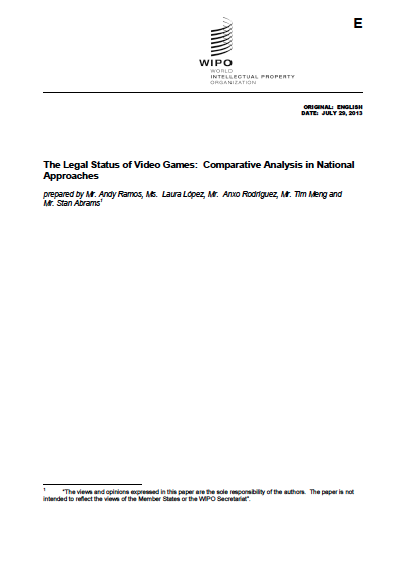
Just in time for (some of) your papers, the World Intellectual Property Organization has released a study called “The Legal Status of Video Games: Comparative Analysis in National Approaches”. Lots of useful information, but as always appropriate academic consideration should be given in assessing the study to the agenda and mandate of the funding organization.

From the introductory press release: “The current landscape of the legal protection of video games appears extremely complex indeed.  Although Article 2 of the Berne Convention provides a solid basis for eligibility for protection of video games by copyright, they are in fact complex works of authorship, potentially composed of multiple copyrighted works.”

The study may be downloaded through the link immediately below:

Screen Shot 2013-10-20 at 6.26.49 PM

jon

Week 6 – 10/16/13: “Ten Cases – Ten Clauses – Ten Contexts” & Roch Ripley Part 2

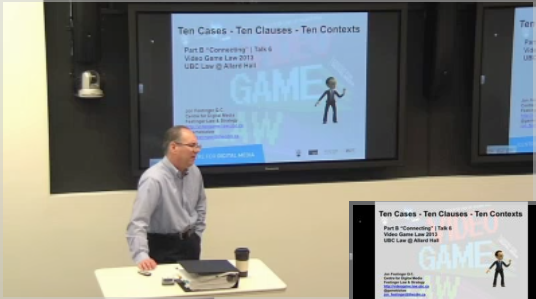
Here are the slides and video of the class. Note especially Roch Ripley’s trenchant and useful critique of the first part of the course as embodied in my previous slides. That said – “Switzerland”…really?

Screen Shot 2013-10-25 at 12.35.18 AM


Screen Shot 2013-10-20 at 1.13.28 AM

Screen Shot 2013-10-20 at 12.11.49 AM

jon

Week 7 Guest Speaker – Anoop Desai

Anoop

Anoop is Director, Business Affairs/Development at Electronic Arts (Canada) Inc. Anoop has been with EA since 2007. Previously he was with Next Level Games and practiced law with Alexander, Holburn, Beaudin & Lang from 2001 to 2005.

At EA Anoop is responsible for:

~ distribution and publishing partnerships for digital platforms in established and emerging territories;

~ defining EA’s business strategy and negotiating deals for new and emerging platforms (i.e. cloud streaming; new OTT gaming devices). Led negotiations to distribute EA titles on select services powered by G Cluster cloud streaming technology.

Anoop’s professional strengths include identifying and evaluating partners, exploring and analyzing various business models, establishing corporate standards and negotiating deals. He will be talking to us about negotiating video game deals and the industry landscape this coming Wednesday morning.

jon

Virtual Property continued…

One interesting angle on this issue is the difficulty posed to recognizing rights in virtual property that arises due to the ephemeral nature of video-game worlds.  Evolving technology, capricious consumers, the game-makers’ efforts to keep their products fresh, and ultimately the success of the game over time all ensure that no virtual world is likely to last forever, and this becomes problematic to the case for recognizing virtual property rights, EULA’s aside.

We discussed briefly in an earlier class whether game-makers could be obligated to maintain a game or server because a user has virtual property in the game that would otherwise cease to exist, which Tyler Dennis touched on in a post last semester: http://videogame.law.ubc.ca/2013/01/25/buying-selling-and-stealing-virtual-property-does-the-current-law-protect-or-disrespect-by-michela-fiorido/

From one point of view, the answer to this is that by the time games are wound up, the property may no longer have “market value” – if people aren’t playing the game, then no one is likely to pay for digital assets in the game.  However, the fact that something has little or no market value doesn’t usually relieve an owner of their property rights in that thing, although it may limit the remedy they are entitled to if the thing is converted.

From another point of view an analogy could be drawn between virtual property and shares in a company that become worthless when a company declares bankruptcy.  While directors might make the decision to declare bankruptcy (or wind up an unprofitable game), in the absence of gross negligence they are not liable for the devaluation of the shares; it is a result of business decisions, which courts usually don’t second guess, and market forces.

On the other hand, game-makers are certainly responsible for property devaluation that they incur by making changes to the game, such as making items more available or introducing more difficult enemies.  Here the game-makers’ right to make changes to improve the game for all players seems like it would trump the rights of individual virtual property owners.  EULA’s seem to effectively address this issue for the time being.

It is possible to envision situations where EULA’s might fall short, however: for example, a creator’s moral rights in an in-game product of their own creation if the product was found to be copyrightable.  It’s sounding like moral rights will come up again later in the course, but as I understand it, an author’s moral rights in copyright are inalienable, unlike their commercial rights, and include the author’s right to not have the work destroyed or disfigured in a way that is prejudicial to the author’s reputation.  The game-maker might own the commercial rights to the virtual property based on the EULA, but be prohibited from destroying it based on the author’s moral rights.  This would again pose an issue upon the “winding up” of a game, even if the property is valueless at that point, if the author can argue that their reputation would be prejudiced.

And all of this concerns the gamer’s rights in virtual property as against the game-maker/service provider.  Rights in virtual property as against other players is a whole different scenario.