Posts

News of the Week: December 11, 2013

1. Snowden papers allege NSA/GCHQ embedded in WoW, XBL

2. The best quotes from the NSA World of Warcraft surveillance papers

3. Spies’ Dragnet Reaches a Playing Field of Elves and Trolls

4. The Daily Show Is Really Worried About NSA Spying In World of Warcraft

5. Daily Report: Tech Giants Call for Curbs on Government Surveillance

6. NSA reportedly ‘piggybacking’ on Google advertising cookies to home in on surveillance targets

7. US Court Secretly Lets Government Share Megaupload Evidence With Copyright Industry

8. The NSA Is Recruiting Teens

9. AT&T shoots down shareholder demands for transparency on law enforcement requests

10. Battlefield 4 Problems Have Shareholder Law Firm Thinking Lawsuit

11. Judge criticized over work-hours Web posts on fantasy game message boards says he will scale back

12.Game Companies Push Back Against New YouTube Copyright Enforcement System

13. Court Approves Atari’s Bankruptcy Exit Plan

14. More Arguing About Women In Video Games. But This Time the Women Can Beat You Up.

15. EA scores 100 per cent for workplace equality

16. Another Questionable Study By Brad Bushman Claims Violent Video Games Are Bad For Children

17. Report: Chinese Government To Loosen Grip On Online Games

18. Kabam to pay $18m for stadium naming rights

19. Ouya now accepts Bitcoin

20. For Bitcoin, Square Peg Meets Round Hole Under the Law

21. Online Retailer Threatens Legal Action Against Customers for a Mistake it Made

22. SOCAN announces new arrangement for YouTube revenues

23. World’s leading authors: state surveillance of personal data is theft

24. 2013 Brought Major Fair Use Wins For Tech, Entertainment

25. Judge Bars Movie Studios From Calling Websites ‘Pirates’

jon

Participating in Wikipedia

The possibilities for working through those class participation marks are quite broad. This semester I sat down with Jon and we hashed out the possibility of summarizing the cases we discussed in class and including relevant entries on Wikipedia. I thought, why should we be the only ones who get to know this stuff? So off I went, learning how to contribute to Wikipedia and write in their weird markup. It’s really not that hard, and I would encourage people to help out with increasing the knowledge base of video game law related articles on the site.

My first, and probably only contribution this semester was Atari Games Corp v. Oman.

To get you started, here are a few links that may help:

News of the Week; December 4, 2013

1. The Player-Authors Project by Greg Lastowka

2. Arrest Made in San Francisco PS4 Killing

3. Why Gamers Can’t Stop Playing First-Person Shooters

4. Are Computer Games “Addictive?”

5. No Girls Allowed: Unraveling the story behind the stereotype of video games being for boys

6. New Barbie Game Is The Stuff Of Nightmares

7. Game Developers Pirate Own Game, Offer it as a Free Torrent

8. Koch Media Acquires Fishlabs

9. Videogame installation combines physical and digital play

10. A Game So Bad It Was Canceled After Release

11. ACTA about to be quietly written into Canadian law

12. German Court Tells Wikimedia Foundation That It’s Liable For Things Users Write

13. Amazon’s petition against collecting New York sales tax rejected by US Supreme Court

14. FTC workshop panelists rethink privacy and security norms for the “Internet of Things”

jon

Use of Personal Information: Is Knowledge Really Power?


In 2003 a law referred to as “Shine the Light” was passed in California. One part of the law requires many businesses to respond to requests from customers about whether their private information was sold for marketing purposes, and who it was sold to. It also requires that the businesses disclose their practices surrounding use of personal information to customers. See a copy of the legislation here: http://www.leginfo.ca.gov/cgi-bin/displaycode?section=civ&group=01001-02000&file=1798.80-1798.84

I initially stumbled upon this because I saw it referenced in the privacy section of a website I frequent, and I asked myself if I would request this information if I were a California resident. The answer, for me, would be no. Not only does it take time and effort to request the information in the first place, but I’m not sure what the benefit would be of knowing. And if I wouldn’t go through the effort after spending all semester learning about how our information is used for all kinds of purposes, who would? Would you?

This law makes me wonder about whether legislation like this really benefits consumers. One advantage I can see is that it allows consumers to monitor how businesses are using their information, and seek to hold the businesses accountable if their information is being used illegally or inappropriately. Does this allow consumers to, in a sense, perform a public service by “policing” the use of personal information for monetary gain? Given what we have learned about contract law not doing much to protect personal information after a person has clicked “I agree”, perhaps creating laws that give consumers tools to protect their own personal information is the next best thing. Customers can fight what they perceive to be misuse of their personal information by choosing which companies they disclose this information to and, more importantly, using word of mouth and the media to generate negative publicity about businesses that use this information in a way they feel is inappropriate.

California recently enacted several other pieces of privacy legislation–a summary of which can be found here: http://www.mondaq.com/unitedstates/x/268076/Data+Protection+Privacy/California+Enacts+Several+Pieces+of+New+Privacy+Legislation

Thoughts?

Week 12 – 11/27/13: “Ethics & Games” & Brian Dartnell

Brian and my PowerPoint slides below. Afraid video is only of me.

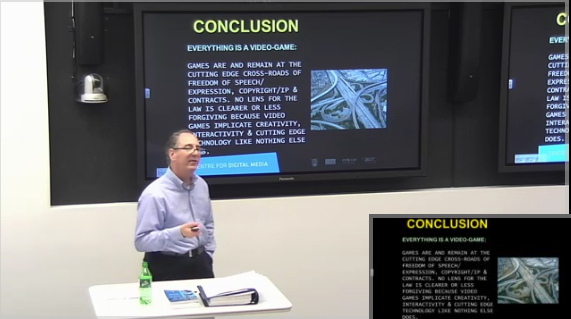
Screen Shot 2013-12-05 at 11.28.15 PM


Screen Shot 2013-11-29 at 1.35.29 PM

Screen Shot 2013-11-29 at 1.37.12 PM

jon

Remixing and Sexism: An Opportunity for Moral Rights Claims?

In class two weeks ago we discussed the systemic problem of sexism in video games. Two examples of this were the “hot coffee” mod in Grand Theft Auto: San Andreas, and the recent “shower screenshots” from Beyond Two Souls.

The Beyond Two Souls example involved a scene in the game that involved the female lead character taking a shower. As produced, the scene was censored by careful placement of the “camera. Of course, some gamer then allegedly accessed the code of the game and “changed” the camera angle—leading to in-game nudity.

This appeared to be inconsistent with the intent of the creators, as Sony has moved to try to prevent such access from becoming widespread.

Ignoring for the moment that the “model” for the game character was Ellen Page, the creators themselves may have been offended by this “alteration” of their game.

A similar recent example occurred with the game Bioshock Infinite.

While I won’t hurt everyone’s brain by attempting to explain the plot of Infinite, the game itself takes place in a fantasy version of 19th century America (a floating-city version of 19th century America… with time travel and inter-dimensional portals). As one would expect from 19th century America, the characters in the game dress quite conservatively. One of the main characters is a teenage girl named Elizabeth

Fans of the game, like fans of many games, have expressed their enthusiasm for the property through their own creations. Some of these creations are drawings inspired by the game. Some of these drawings are posted on internet websites like deviantart. Some of these deviantart postings are borderline pornographic.

At a recent conference, Ken Levine, the creator of Infinite, took the opportunity to speak out against this “sexualization” of the character of Elizabeth.

Referring to the deviantart depictions, Levine half jokingly commented “I die a little inside with every page view”. To him, “it’s like coming across a picture of your daughter”.

These unauthorized attempts to sexualize female characters in games can be said to damage the integrity of the work—a breach of the creator’s “moral rights”. Such integrity is protected in Canada through section 14.1 of the Copyright Act.

Admittedly, only one plaintiff ever successfully argued a claim for “moral rights” protection. In Snow v The Eaton Centre Ltd, Snow, an artist, successfully obtained an interlocutory injunction against The Eaton Centre to prevent them from placing ribbons on a sculpture of Geese he had sold them. Apparently, many well-respected artists testified in support of Snow’s claim that the ribbons “looked ridiculous”.

The sexualization of these games would seem to go beyond the “be-ribboning” that occurred in Snow. While the fact that there remains no other example of a successful claim for moral rights in Canada does not instil confidence in the power of the provision, it is interesting to consider the availability of such claims in cases of overt, and unauthorized, sexualization.

For further discussion of moral rights and video-games, see Michela Fiorido “Moral Rights and Mods: Protecting Integrity Rights in Video Games” (2013) 46:3 UBC L Rev 739.


News of the Week; November 27, 2013

1. NCAA sues EA over settlement with former players

2. Turbine Settles Lawsuit with Treehouse Avatar Technologies

3. Microsoft: ‘We plan to take care of customers’ with faulty Xbox Ones

4. Official Report Does Not Tie Sandy Hook Shooting With Video Games

5. Violent video games may stop crime by keeping criminals busy playing violent video games

6. Irish Male Teens Who Game Online Are More Social With Other Cultures

7. Playing Computer Games Together Makes Brains Feel and Think Alike

8. Blizzard dev apologises for attitude to over-sexualised characters

9. Popular iOS app QuizUp is full of security holes, fix on the way

10. Life Inside a PlayStation

11. Where Film Marries Video Game

12. New Cyberbullying  Bill Resurrects Many Police Powers From Scrapped “Lawful  Access” Bill

13. Beyond 3-D Printers’ Magic, Possible Legal Wrangling

14. MPAA Revenue Up 50% As “War on Piracy” Cranks Up

15. Pressure Mounts on Wireless Providers Over U.S. Surveillance Efforts

16. N.S.A. May Have Tapped Internet Cable Links

17. Twitter Toughening Its Security to Thwart Government Snoops

18. Microsoft To Encrypt Data Center Links; Says NSA Hacking Would Be Unconstitutional

19. The FISA Court’s Problems Run Deep, and More Than Tinkering is Required

jon

Week 12 Guest Speaker – Brian Dartnell

Dartnell

We are fortunate to have Brian Dartnell who is Senior Counsel at Electronic Arts as our Guest Speaker. Brian is celebrating his eighth year with EA this month and will be giving us an overview of the myriad roles counsel plays within a very large video game production and distribution entity.

Brian’s bio (from Linked In):

Senior Counsel, Electronic Arts: November 2005 – Present (8 years 1 month)Vancouver, British Columbia

Responsible for the oversight and management of the legal team in Canada and the delivery of legal services to EA’s Canadian operations. Currently EA operates in 5 Provinces with more than 2000 full and part time employees based in Canada.

The Canadian legal team consists of three lawyers, a paralegal, an immigration specialist and an administrative assistant.

Responsible for providing advice, delivering training and assisting in the development of policy for internal clients on a broad range of legal issues including:

a) “People Matters” – employment, immigration, compensation and benefits, human rights, workers’ compensation, privacy, pension and benefits, and performer related issues;
b) “Corporate Matters” real estate, M&A, licensing, and ecommerce; and
c) Litigation – management of Canadian based litigation

Associate, Gowling Lafleur Henderson LLP: April 2000 – November 2005 (5 years 8 months)

Employment and Labour Law Practice

Associate, Owen Bird Law Corporation: March 1998 – April 2000 (2 years 2 months)

General Litigation Practice”

jon


Week 11 – 11/20/13: “Controlling the Controllers” & Sheridan Scott

My slides and video of both presentations below. As always apologies that the capture system has to cut off ten minutes before the class ends so it can be ready to go in advance of the next class. On the positive front looks like the ghost in the machine causing the 20 second audio blackout is being worked on so hopefully the fruits of those labours manifest across the video board sometime soon.

Screen Shot 2013-11-24 at 8.07.10 PM


Screen Shot 2013-11-24 at 7.50.59 PM

jon


Isn’t there a right to be ourselves?

photo

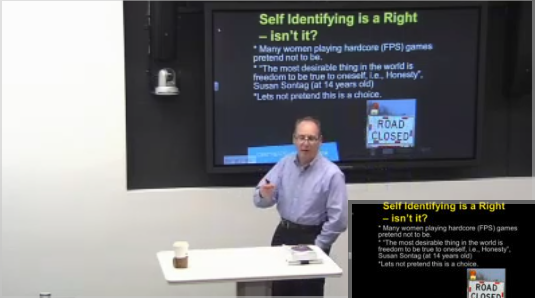
“The most desirable thing in the world is freedom to be true to oneself, i.e., Honesty” – Susan Sontag (at 14 years old)

Following our two most recent classes,  this post  on the subject of the overt discrimination against women in games might be helpful in crystallizing some of our discussions. At the very least, it is cathartic (for me). The problem to be explored is:

1. There are a large number of hardcore women gamers.

2. Almost all women gamers who play games like Call of Duty or Battlefield (the biggest games of the FPS genre) play as “men”. That is they change their on-line identity to a male one.

3. They do this because to be identified as a woman in these on-line environments generally makes them subject to intolerable amounts of abuse. In essence if women want to play they  have little alternative but to pretend they are not women.

Having set out the problem, allow me to outline two fears around this post.

The first fear is of being trite. So many powerful, thoughtful and brave contributions exposing and illuminating what amounts to the immorality of the self-absorbed and the stuck have already been made.  My colleague at the Centre for Digital Media (and our guest two weeks ago) Dr. Kimberly Voll even organized the extremely successful “I Am a Gamer” game-jam (photo above) at which men and women worked night and day over a weekend to build games which had strong female protagonists. Anita Sarkeesian’s “Trope” series was not only a thoughtful contribution, but came at great personal cost in terms of the abuse she absorbed – all of which effectively proved her point in a way that civilized debate could not. Was it worth the abuse though? That question gets us closer to my take on all this.

Another fear is my own anger. As the second sentence in the paragraph immediately above reasonably illustrates, I am close to losing it on this subject. It is all too easy to call out the “idiots” who abuse on-line because of my complete certainty that that is exactly who they are. Equally there is little doubt in my mind that a responsibly administered battery of psychological testing would reveal much in common and of interest among them – and not much that is truly worthwhile. Better stop there lest all academic pretext goes out the window…

The problem is of course that anger generally helps little, and puts me in league with exactly those I am repulsed at being identified with. Clarity helps much more. The issues seem to involve the most basic of human rights. That is precisely what most engages my anger. We are, after all, talking about rights of equality and rights to not be personally abused. Rights which are necessary to a civil society. Specifically the ability to freely self identify as who we actually are. That is “to be true to oneself”, in the words of the young Susan Sontag.

In the seven years that I’ve been privileged to teach Video Game Law approximately 15 – 20% of the class have been women. Some, if not most, were avid gamers. Many were knowledgeable and  accomplished FPS’ers. Sadly it was only a few months ago that,  in answer to a question, one of these avid and committed gamers explained that she would never go online in an FPS as a woman because of the abuse she would receive. Instead she pretends to be a guy.

Directly stated, the lawyer in me recoils in horror at our seeming inability to allow individuals to represent as their actual identity. That seems so basic. There must  be a mechanism that allows people to be themselves. Surely? The very thought that people have to deny who they are to get to do something they want to do makes us feel collectively ill.  Doesn’t it? Shouldn’t it?

All over the world and throughout time, minorities have  altered their appearance in order to approach the same economic footing as the majority. Or far worse they pretend to be like the majority in an attempt to survive horrific ethnic, political and cultural “cleansing’s”. That something even remotely along those lines is happening right under our on-line noses should be beyond disturbing. What’s missing? The problem seems hardly ever to be directly called out. Moreover it seems even more important to me because it is very different from the debates on correlations/causality between virtual violence and real violence. The problem we are talking about is real abuse actually happening, not theoretical connections which may or may not be someday proven.

Our class discussions of the last two weeks leave the tentative conclusion that  provincial human rights complaints may be the most realistic recourse. Even then there are real complications. It is not helpful to repeat all that appeared in the class slides here. Were that to be done this post  would become insufferably long.  In summary though, clarity seems unreachable. Which leaves me with anger. Which is just not good enough…

jon