Ian Verchere who is co-founder and the Chief Creative of Roadhouse Interactive, a 50-person production and development company shaping the future of mobile, tablet and online games will be our guest next class. Ian will share his views of ongoing dialectic between creating and the law.Ian has been a great friend of the course, providing challenging insights from the creators’ perspective each of the last three years. Ian’s particular gift is for illuminating the paradox of legal structures which constrain creativity while seemingly seeking to protect creative enterprises.
From Ian’s LinkedIn profile:
“Verchere is a creative producer, writer and visual artist. Since graduating with honors from the Emily Carr Institute of Art and Design (ECIAD) in 1989, he has been involved in the creation and production of over 30 video and computer games, including creative producer on the million-plus selling SSX Tricky and NBA Street V.2 for Electronic Arts, and designing and producing the classic, best-selling Sega Genesis title Beavis and Butt-head for MTV.
Verchere was one of the founders of Radical Entertainment, and was instrumental in growing the company into one of the world’s largest independent game developers. After serving as Studio Creative Director, he left in 1998 to join Electronic Arts (Canada) as a Producer.
In 1994, he wrote and directed The Divide: Enemies Within for Sony PlayStation. This award-winning title was recognized for its original story, and for the innovative CG short film that opened the game. In 1998, he brought the greatest action star in the world to the video game world, signing Jackie Chan to an exclusive worldwide deal.
He co-wrote Mom’s Cookies, a screenplay with Douglas Coupland that was bought by Disney, and is a member of the WGAw. As Executive Creative Director for Millions of Us, he helped MoU secure an exclusive agreement with Sony to create and develop virtual worlds and lobbies for PlayStation Home, including Sony’s own Home Lobby and Orientation Experience.
Verchere founded Roadhouse Interactive with James Hursthouse and Tarrnie Williams , and leads creative there.”
This is a terrific talk Paolo Pedercini of Carnegie Mellon University gave remotely to Indicade East 2014. It is hugely thought provoking in its interpretation of games as rationalizations of capitalism. I don’t agree, hewing to Jung’s view of games (see Talk 1) as a way of being in touch with our instinctive self. Of course the “too clever by half” way to bridge the gap is to suggest our instinctive selves are capitalistic. So the creator of the game is both in touch with their instinctive self and as a result building game structures that reinforce capitalism.
Here is the tough part. If the language of games is indeed inherently capitalistic there might be legal consequences. Wouldn’t that make it all the more challenging for legal interpretations to acknowledge the mutually dependant roles of developer and gamer from an intellectual property perspective?
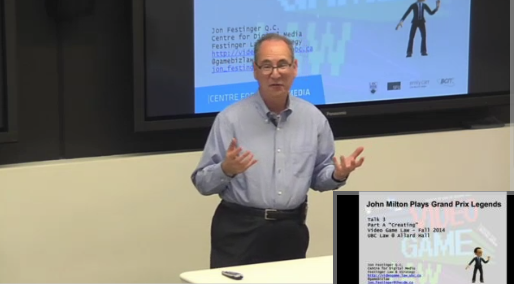
Here are the videos and slides. No big glitches this week – a short lag of a couple of seconds off the top. The good news is that we all stood where we were supposed to (except for Roch’s “drift” at the beginning of his talk 😉
Roch Ripley is a great friend and co-author of the 2nd Edition of Video Game. He is a partner in Gowlings’ Vancouver office and is co-chair of their Technology Industry Group. He has been an Adjunct Professor in this course and has always been very supportive of its goals. He will be speaking to you in the second hour this coming Wednesday (Sept. 17, 2013). Roch will share his perspectives, focussing primarily on End User and other agreements, which have become such a huge part of the video game law landscape.
Roch is a serious fan of the Street Fighter video game series.
To borrow from the Gowlings bio of him:
“His areas of expertise include computer-implemented and software technologies, integrated devices, clean technologies and electronics. A registered patent agent in both Canada and the United States, Roch has significant experience drafting and prosecuting both domestic and foreign patent applications, opining on patent infringement and validity, conducting technology audits and advising on how to utilize copyrights, trade-marks, industrial designs, and trade secrets in addition to patents to best protect technology. To help his clients profit from intellectual property, Roch drafts technology licenses and development agreements, handles intellectual property aspects of technology company financings and enforces intellectual property rights against infringing parties.
PAPERS & PRESENTATIONS• Co-author, “T-shirt tempest tests copyright law,” Vancouver Sun, February 2013• Adjunct professor at the University of British Columbia teaching Law 450: Video Game Law with Jon Festinger (Spring 2013)• Video Game Law, 2nd ed., Markham, ON: LexisNexis, 2012. Co-authored by Jon Festinger and Chris Metcalfe• Author of summaries for the Canadian Bar Association Intellectual Property Review, including: “Use of Term “Substantial Payment” Renders Settlement Document Unenforceable” (Feb. 2011); “Federal Court of Appeal Clarifies Meaning of Patentable Subject Matter” (Nov. 2011); “Court Rejects Opposition of WRANGLER Mark Based on Lack of Confusion” (June 2010); and “Court Decides What Evidence to Admit Pursuant to Rule 289” (May 2009)• “The Interconnection of Intellectual Property and Cultural Property.” Protection of First Nations Cultural Heritage: Laws, Policy, and Reform. Eds. Robert Paterson, Catherine Bell. Vancouver, BC: UBC Press, 2009. Chapter co-authored with Robert G. Howell”
Here are slides and video from our second class. Thanks to Brian Dartnell for giving us a terrific overview of his life as EA’s lawyer at EA.
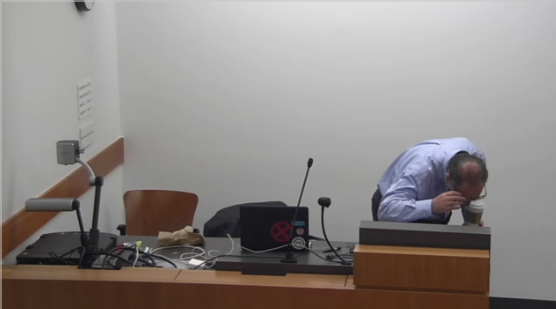
You may wonder what it is I am (symbolically) looking for in the picture below. Turns out the video of the class is missing – well, not exactly missing…the presets for the camera were aiming at the podium on the side of the room (where you see me below) and not the table at the center of the room where Brian and I spoke from. So, as you will see, the video of this weeks class is composed of the slides and our audio. The effect is actually pretty good – some might say better (for a variety of reasons 😉
Also if you are wondering the difference between the top and bottom videos just have to do with screen size. The top one puts you into the Mediasite page and allows you to then expand the picture to full screen. The one just below that is an embedded version of Mediasite which works great in the browser provided but can’t be expanded. Hope that makes sense.
This week a few reflections on misogyny, gamers and the Anita Sarkeesian debacle. As well as a quick take on Microsoft’s resistance to a domestic warrant for overseas materials.





 Check out theVideos of Interest to Law 423 on YouTube
  Communications Law
 Join the Community!