Posts

$19,000 to play League of Legends.

I spotted this on my newsfeed this morning and jokingly sent it to my brother (an avid gamer who’ll hopefully be off to university in a couple of years). Robert Morris University has offered a huge scholarship (up to $19,000) for people to play League of Legends. A quick Google search told me that RMU’s average amount of institutional aid awarded per student is $4,331.00. $19,000 is a sizable chunk of money for something that is not a traditional athletic scholarship.

Last year in Trusts I learnt that originally a trust for a “mere game” with no educational value was not charitable (Re Nottage [1895] 2 Ch 649, per Lindley LJ at 655). Over time, charitable money for the promotion of sport was allowed if it was for educational purposes. This included the interesting scenario where chess was recognised as a sport due to its educational nature (Re Dupree [1945] Ch 16). Currently, the Charities Act 2006 allows money left for the promotion of amateur sports to constitute valid trusts. Amateur sports are defined in section 3 (2)(d) as in “sports or games which promote health by involving physical or mental skill or exertion”.

Although trusts don’t have very much to do with the general acceptance of eSports, it is interesting to note that other non-physical sports which require skill are recognised under English law. Moreover, it raises interesting questions about leaving money in trust for scholarships to play eSports. My question to the class is this – with a university offering scholarships to attract top players and professional competitions drawing huge crowds, is it finally time to fully recognize eSports as a legitimate athletic endeavor? I’d also be very interested to hear if there is any Canadian precedent on this issue.

Note – my brother texted back and said he doesn’t play League. Maybe UBC will start offering Halo scholarships though?

News of the Week; October 15, 2014

GAMES

1. What Is Gamergate, and Why Is Intel So Afraid of It?

‘Massacre’ threat forces Anita Sarkeesian to cancel university talk

Brianna Wu is latest dev threatened and driven out of home

Gamergate’s vicious right-wing swell means there can be no neutral stance

“There is a literal war in this industry on women” – Wu

Angry misogyny is now the primary face of #GamerGate

Editorial: The Truth About GamerGate and GameJournoPros

2. Gender segregation in e-sports is indefensible – and yet …

3. SHOCKER: An Anti-Video Game Psychologist Turns Out To Be A Lousy Scientist

4. Are Lindsay Lohan and Manuel Noriega right to sue over video game likenesses?: The Hollywood actor and the former Panamanian dictator are suing over the use of their likenesses in video games, yet the law is rather ambiguous on the issue

Linsday Lohan’s Lawyers Modify Focus of ‘GTA V’ Lawsuit Against Take-Two

Amended Complaint From Lindsay Lohan Against Take Two: Now With Five Times More Paper!

Call of Duty Lawsuit: Noriega Making Mockery of Legal System, Activision Says

5. Kim Kardashian: Hollywood Now Recognizes Same Sex Marriage

6. The esports revolution: The dark side of livestreaming entertainment

7. Video Game Thwarts Defendant in Boston Marathon Bombing ‘Obstruction of Justice’ Trial

8. Driveclub server issues continue

9. Requiring YouTubers To Give Positive Reviews For Access To Games Can’t Work As A Long Term Strategy

10. Video Games, Henry Ford, And The Problems Of Modern Education

Ian Livingstone Hopes to Launch School That Utilizes Video Game-Based Curriculum in 2016

How Videogames Like Minecraft Actually Help Kids Learn to Read

11. How Online Multiplayer Ate The Videogame Industry And Turned The Internet Into A Battlefield

12. The Return Of The Video Game Auteur

13. You Can Create A Hit Video Game About Anything. Even Making Toast

14. The Death of Reviews

15. Texters and Gamers: Video games are a brilliant art form or the end of the world. But what about the other game — the one we all play, all day every day?

DIGITAL

16. EFF to Court: A Trademark Is Not A Censorship Tool

17. Our Digital Future: New report and agenda for copyright reform

18. Draft Declaration Of Internet Rights: (Text drafted by the Study Committee on Internet Rights and Duties of Italy’s Chamber of Deputies)

19. Hipster net neutrality group’s mysterious backer gets outed: It’s the cable companies

20. The Danger of Letting Monsters Pass As Internet Trolls

Why Haters Hate: Kierkegaard Explains the Psychology of Bullying and Online Trolling in 1847

21. The Unsafety Net: How Social Media Turned Against Women

22. Microsoft CEO Opens Mouth, Inserts Foot On Gender Pay Gap

23. Silicon Valley’s Empathy Problem

24. Facebook is unleashing its ads—and surveillance—onto the internet at large

25. Mass surveillance killing Internet privacy, UN report says: UN counter-terrorism envoy Ben Emmerson says widespread use of mass electronic surveillance by intelligence agencies signals the death knell of privacy on the Internet.

26. Google has removed 170,000-plus URLs under “right to be forgotten” edict: Google weighs public interest, accuracy and relevance

27. America Must End Its Paranoid War on Hackers

28. CETA – what does it mean for IP in Canada?

29. SoundCloud Posted A $29M Loss In 2013 On Revenues Of $14M

30. How to become internet famous for $68: The secret of online celebrity Santiago Swallow.

31. The Internet Is Not Harming You. Here’s What’s Harmful: Fearmongering About The Internet  

CONSTRAINTS

32. How to Pirate a Book on Copyright Law: What I learned remixing a 250 page copyright treatise into a website about fair use.

33. Hong Kong’s Wild Protest Art: It’s spontaneous and participatory — and the state can’t control it.

34. Cloud this: Adobe has been screwing art students out of the CS6 licenses they paid for

35. Comedy club charges per laugh with facial recognition

36. Graffiti, vandalism, and public expression: public art and its uneasy relationship with the law

37. Why is a US radio station getting a notice about webcasting royalties in Canada? – why webcasters geo-block their streams to avoid international music royalties

38. What the pre-1972 Decision Really Means for the Future of Radio…

39. Why Isn’t Fair Dealing Enough?: Government Considering Copyright Exception to Cover Political Advertising

Broadcaster Copyright Misuse and Collusion?: Why Criticism Over the Government’s Political Ad Copyright Exception May Be Pointed in the Wrong Direction

Attack Ads, Copyright, and Collusion: Have Canada’s Major Broadcasters Violated the Competition Act?

40. Bono Apologizes For Putting Free Music On Y our iPhone

41. U2: ‘It’s the job of art to be divisive’

42. Dorian Nakamoto, fingered as Bitcoin creator, wants to sue Newsweek

jon

The Line Between Code and What You See

Don made a very interesting point in today’s talk about distinguishing who owns the rights to some computer code (the developers), versus who owns the rights to the actual look-and-feel / expression it creates (the studio).

I just wanted to add that the line between the two is not always a clearly drawn line in the sand.  There was a very significant case decided early this summer by the Federal Circuit in the US, that I’m sure we’ll hear much more of in the future (think: SCOTUS).  That case is Oracle v. Google.

There were two main issues in Oracle: is there copyright in an application programming interface (API), and how much code has to be copied for literal copying of code to be an infringement.

APIs

In a nutshell, an API would be like the “interface” to, say, a game engine.  So I could write a game engine called RyanPeopleMover which has an interface that looks, in grossly (!) simplified form, like:

createPerson(name, initialXPosition, initialYPosition)
movePerson(name, amountX, amountY)

You could create and move people using this game engine by writing things like:

createPerson(Alice, 10, 15)
createPerson(Bob, 50, 60)
movePerson(Alice, +15, -5)
movePerson(Bob, -30, -20)

But, what if Jon came along and wrote his own game engine, JonMakeAndMovePeople, that used the exact same interface, but had different code behind it? Maybe his code has a better implementation of movePerson that, for example, performs the requisite mathematical computations more efficiently. Developers love when people create and utilize standardized APIs. If you were using my people-moving game engine before, you could swap mine out and Jon’s in, improving efficiency, without having to change any of your code. If I later change RyanPeopleMover to make it even better, you can swap my new version back in with essentially zero effort.

But, is Jon infringing on any of my intellectual property rights by using the API I created, even if the code behind the interface is different?

The facts of this case are that Oracle owns Java — a programming language with a large library of “pre-coded” functions for programmers to use. For example, I could write something like:

Math.round(userInput)

to take the user’s input and round it to the nearest whole number. Math.round(number) is part of Java’s standard library API. And, to be clear, Java’s standard API is massive, and performs tasks infinitely more complex than rounding numbers. Google, on the other hand, owns Android (the cell phones). Google wanted developers to be able to write apps for Android in a language they already knew, and allow existing Java programs (in general) to run (near-)effortlessly on Android. So Google copied large portions of the Java API to use as the Android App API.

The Federal Circuit held that there was copyright in an API, and that Google had violated Oracle’s copyright. I’m a software developer, so I’m sure everyone can guess my thoughts here. But, what are yours?

How Much Copying is Copying

The second key issue in Oracle is how much code (behind the API — the actual implementation of the interface) needs to be copied for it to be copying?

The facts of this case are that there are nine lines of code in Google’s implementation of one function it’s Java-ish language that are identical to the nine lines of code in Oracle’s (open-source) Java implementation.

Google had attempted to make sure there were no copies of implementation code in its Java-like language. They had performed a “clean-room implementation” of the Java functions (i.e., make the Google developers write the code to implement the API without looking at Oracle’s openly available implementations). But, one Google developer copied the code for a simple little function directly from the Oracle version (as a quick stopgap), and forgot to reimplement it another way.

Now, copying nine lines of text from a book, I think we can all agree, counts as “actual” copying. But how about lines of code?

I’ll try to keep the computer-babble to a bare minimum (one paragraph only, I swear). But, to describe the potential impact of the ruling, I need to babble briefly. One of the most common ways to store data in a computer program is contiguously in memory. So, if I had to store the numbers 10, 15, 20, and 30 in memory (say, as the X and Y coordinates for Player 1 and Player 2), I would often place them back-to-back in memory. This is called storing the numbers in an “array”. Then, I “index” the numbers in the array, so that I can retrieve or modify them. In Java, arrays are always and automatically indexed from 0 to one less than the size of the array. So, array[0] is 10, array[1] is 15, array[2] is 20, and array[3] is 30 (i.e., an array of length 4 is indexed from 0 to 3). A really simple programming bug to make is to accidentally access an array too high or too low, i.e., try to access array[-1] or array[4], which will access and possibly modify memory that contains who knows what (leading to bad, bad bugs). The Java programming language is nice — programs written in Java automatically detect if they attempt to access too low or too high in an array, and crash on detecting this happening (For those of you not from a computer background, trust me when I say that crashing is infinitely preferable to just allowing the illegal array access to occur).

Now, with that explained, there’s a very simple bit of code in the Java implementation that has one task: to take a range of indices, and ensure the entire range is legal. If it is, do nothing; if not, make the program crash. So, from the above example, if I asked if array[1] to array[3] is a legal range, nothing should happen. If I asked if array[1] to array[4] is a legal range, the program should simply choke, die, and spew error messages that are incomprehensible to anyone but programmers.

The implementation in Oracle’s Java, which took nine lines of code, looked (in interpreted fashion) like this:

rangeCheck(arrayLength, lowIndex, highIndex):
if (lowIndex is greater than highIndex) - throw errors and die
if (lowIndex is less than 0) - throw errors and die
if (highIndex is greater than or equal to arrayLength) - throw errors and die

That much code was all it took for the Federal Circuit Court to find that Google’s copying was, in fact, not de minimis copying. It has been remanded back to district court on Google’s potential for a fair use defence.

In my opinion, if you put 1000 experienced Java programmers in a room and asked them to implement the rangeCheck(arrayLength, lowIndex, highIndex) function, about 400 would implement it as above, about 400 would implement it as:

rangeCheck(arrayLength, lowIndex, highIndex):
if (lowIndex is less than 0) - throw errors and die
if (highIndex is greater than or equal to arrayLength) - throw errors and die
if (lowIndex is greater than highIndex) - throw errors and die

and the remaining 100 would ask why you brought them all the way to this room, just to implement such a simple piece of code that should only take nine lines to write.

(Edit: Haha, oh dear. I was going to edit the above paragraph, because I’m embarrassed by my stupidly simple math error. But, I decided to leave it as-is, because it’s a perfect demonstration of an off-by-one error — meaning accessing one-too-low or one-too-high in an array. 4+4+1 = 10, uhh, right?).

Now, to play devil’s advocate, there is still the text of the error messages spewed by the Java implementation, but the amount of text is incredibly minimal. One of the error messages, for example, would read, “lowIndex(3) > highIndex(2)” if lowIndex was 3, which is greater than highIndex which is 2 — the kind of brief error message most any programmer would use.

So, minimal or not?
Video-Blog News of the Week; October 8, 2014

This week “If you don’t laugh, you’ll cry” featuring “Shadow of Mordor”, what the military can learn from game marketing and President Erdogan of Turkey. Unfortunately no time for Lindsay Lohan and Manuel Noriega 😉

jon

Copyright law amendments for political advertising (& what that has to do with video game law)


This is an interview I gave to Andrew Chang of CBC News at 5 on Thursday, October 9, 2014. It is on the subject of possible (not yet proposed) amendments to the Copyright Act which would create a “fair dealing” exception in favour of political advertising. I basically go through the various reasons why this may not be such a great idea. The core argument does hit on a bit of a recurring theme of this course. That is the status of copyright law in a digital age where “using online stuff” (if you can forgive me for putting it so crassly) has become integral to how we communicate with each other in a free and democratic society. Its analogue is modding/gaming as a form of communal creative expression. As you will see my objection is really only to the double standard inherent in the government wanting to pass such legislation. Creating an exception for any narrow and privileged group seems objectionable. The problem exists of user rights that are too narrow definitely exists, as the desire for these possible amendments makes clear. Thinking of depriving the majority of Canadians of needed rights while protecting a privileged class of user is the obvious and unfortunate irony.

Besides, what happens if something like this actually goes through – do online curators and creators become political parties just to be safe? 😉 Silly stuff indeed.

The best piece on all this, which as you will see I essentially adopted (without crediting – my bad in the spur of the moment – though I did credit in the pre-interview) is that of Professor Michael Geist. You can find it here: http://www.michaelgeist.ca/2014/10/isnt-fair-dealing-enough-government-considering-copyright-exception-cover-political-advertising/

Reactions/counter-arguments?

Thanks to Tina Lovgreen of CBC for making the interview available.

jon

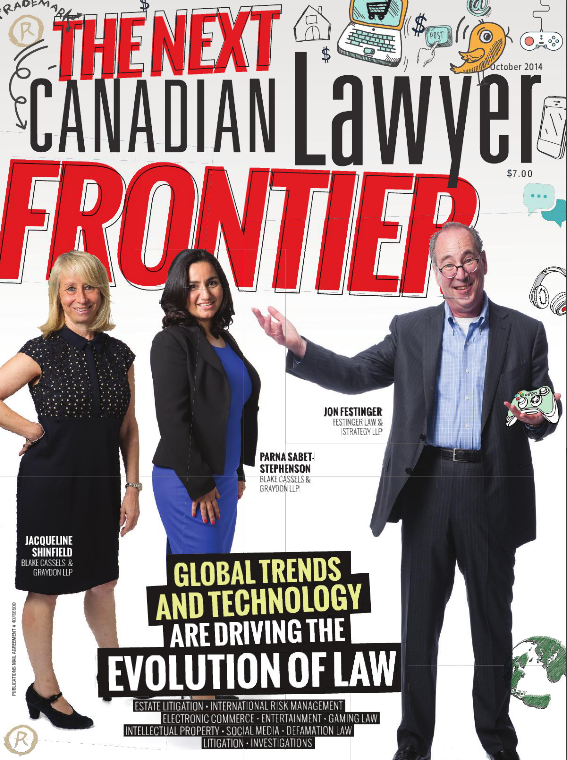
“The Next Frontier” – Canadian Lawyer, October 2014

Screen Shot 2014-09-29 at 8.59.46 PM

You may notice a familiar face on the cover of this months Canadian lawyer magazine. This essentially came as a surprise as I gave an interview many months ago and had  no idea whatsoever that I might end up on the cover of a magazine. It is particularly nice that video game law is identified as being among “The Next Frontier” trends driving the evolution of law. Hyperbole aside and for whatever it’s worth here are the excerpts from the story that you may find relevant:

“Originally a freedom of expression lawyer who started out acting for newsrooms, Jon Festinger of Festinger Law & Strategy LLP teaches video game law at the Faculty of Law at the University of British Columbia. He says there is a component of hardcore gamers in his classes and many are entrepreneurial by nature, creating a new breed of lawyer who wants to leverage their love of gaming into business. “In entertainment law courses these days, largely because of digital media, you will find students who have actually been part of a media company or write blogs or have written a pilot for television because the barriers to entry have gone down in the last 10 to 15 years,” he says. “Video games were the basis for all of these things we think of as giant changes in the world today — social media, 3D, smartphones — all of these things had their first betas in video games because there was money in video games,” he says.

Festinger says the lawyers who know video game law best right now are almost exclusively in-house. “You have to have such an intimate understanding of what the clients want and paying an outside law firm to come up to speed on the particularly specialized issues of gaming law is not cost effective,” he says. “There are some outside counsel who do this but it’s not a file you just land on some lawyer’s desk. It matters whether they play games nor not — it matters that they grasp the issues.”

What doesn’t matter, however, is how small a video game company is because once launched it becomes part of a worldwide business. “That’s the huge paradigm shift in this business,” says Festinger. Finnish video game maker Rovio Entertainment Ltd. and its hit franchise Angry Birds is a perfect example. “Suddenly as soon as you launch that game in the app store you are a worldwide business,” he says.

When it comes to intellectual property in the gaming world, things get really interesting for lawyers. “We’ve sort of moved into a contract world that deals with intellectual property rights but in the world of contract law. We’ve converted it,” says Festinger. “It’s created a ton of work for lawyers. There’s huge criticism around 40-page terms-of-use documents and so now companies like Microsoft are trying to simplify it, which is not bad for lawyers because guess who is doing it? It’s still us.”

The other part of the boom are the deals going down — digital media generally remains a healthy part of the economy.”

jon

Week 6 – 10/8/14: “Frictions & Fictions: Ten Cases-Ten Clauses-Ten Contexts” & Mavis Dixon

Here are video and slides.

jon

Screen Shot 2014-10-11 at 4.55.51 PM


Screen Shot 2014-10-11 at 4.37.25 PM


Screen Shot 2014-10-11 at 4.38.46 PM


Week 7 Guest Speaker: Don McGowan of The Pokemon Company International


Don_headshot

This week Don McGowan of the Pokemon Company International will be making the trek north from his home in Seattle to join us. Don will talk about video game contracts and turning IP into a franchise. Don is particularly well qualified on these subjects. He has, since August 2008, been the General Counsel of The Pokémon Company International. His responsibilities include oversight of all video game work for every game the company has produced during that time, many of which have sold over 10 million units worldwide and include titles produced for the Nintendo DS and Nintendo Wii, as well as a free-to-play PC title based on the Pokémon trading card game. He has also handled all TV and movie deals for the Pokémon property outside of Asia, as well as all merchandise licensing in that same geography, and was instrumental in creating Pokémon’s recent Pokémon TV app for iOS and Android (over 1 million downloads in the first week).

Before Pokémon, Don was the head attorney for Microsoft Game Studios where he had sole responsibility for all games published by Microsoft or licensed using Microsoft IP for the Xbox 360, PC, Nintendo DS, and mobile platforms. The games he worked on included Halo, Mass Effect, Project Gotham Racing and Forza Motorsport, and Flight Simulator; each of those was a multi-million unit seller. He also worked in Microsoft’s government affairs department where his responsibilities included briefing Congressional and state legislative representatives and officials on technology-related issues. Prior to that, Don worked as a litigator in Montreal, Canada for Osler and Stikeman. He has also been a failed standup comic and paid his way through law school in part by narrating romance novel books-on-tape.

Don speaks English and French fluently with some German and Spanish. His outside interests include teaching his Entertainment Law class at the University of Washington, as well as rugby, and (really slow) marathon running.

We are very fortunate to have Don join us.

Jon

Panel Discussion on Orphan Works at Vancouver international Film Festival; October 10, 2014

Screen Shot 2014-10-09 at 5.28.28 PM


After the VIFF screening of the classic Canadian film “Bye Bye Blues” October 10, 2014  at the Vancity Theatre (1181 Seymour Street, Vancouver B.C.), I will be on a panel discussing how the film was “recovered” using  section 77 of the Copyright Act dealing with so called “orphan works”. “Bye Bye Blues” will be screened at 2:30 PM and the panel which includes Professor Joel Bakan of UBC Law and Professor Colin Brown of SFU convenes at 4:30 PM.

jon

News of the Week; October 8, 2014

GAMES

1. U.S. Supreme Court Denies EA’s Motion to Appeal Ruling in ‘Keller v. EA’

2. German Court: Key Selling infringes Copyright

3. Square Enix Sues SNK Playmore

4. Report: YouTubers Making ‘Middle-earth: Shadow of Mordor’ Videos Strong-Armed by PR Firm Representing WBI

5. Australia, Steam and consumer legal rights in video games (Jas Purewal)

6. List of ethical concerns in video games (partial)

7. ‘Gamers’ don’t have to be your audience. ‘Gamers’ are over.

8. CD Projekt Reiterates its Hate for DRM

9. Are Addictive Free-To-Play Games Ethical? Let’s Fight!

10. Can you use other companies’ trademarks in your video game?

11. US military can learn from game marketing, says ex-Call Of Duty director: Dave Anthony believes unpopular national security solutions can be pushed just like new game features

12. Intel: “We are deeply sorry if we offended anyone”

13. How EA’s jet-setting founder avoided $26 million in taxes: “I bought a private jet because I thought it would make me more efficient in my work.”

14. Chinese Mobile Game Uploads Almost 36K Private Videos Online Without Permission or Warning

15. Report: South African PlayStation Plus Subscribers See Substantial Rate Increase

16. The Messy Story Behind YouTubers Taking Money For Game Coverage

17. Twitch, Steam now require disclosure of sponsored content from users: New policies require paid support to be explicitly stated in text and graphics.

18. Study by Villanova, Rutgers professors shows video games may actually reduce violence

Brad Bushman Study Concludes That Most See a Correlation Between Video Games and Aggressive Behavior in Children

America’s Army and the Military recruitment and management of ‘Talent’: An interview with Colonel Casey Wardynski

Computer games: fun or wrong?

CBS Commentator Urges Gamers To Go Play The Real World

19. Gaming to Pay the Rent: Millions in prize money and ESPN-sized audiences at stake

20. How Videogame Currencies Could Effect Real-World Economies

21. Tiny Death Star pulled from app store, devs “had no prior knowledge”

Avoiding the Tiny Death Star: reducing risks of a published game being canned (Jas Purewal)

22. Report: Bomb Threat Was Not Directed Specifically At Gearbox Software

23. Massive acquisitions put M&A value up to Q3 2014 over that of 2013 entire

24. Japan is just a symptom of Xbox’ problems

25. The Three Lives Of Blizzard Entertainment

26. You Can Now Drive Rainbow Road in Gaming’s Most Realistic Racer

27. Microsoft Research demos our potential, holodeck-style gaming future: Kinect and projectors combine for room-filling games on the walls and floors.

28. Candy Crush Saga, not PS4 or Xbox One, dominates ads on the airwaves

29. The Birth of Pong: How Nolan Bushnell jump-started the video game industry from an abandoned roller rink. 

DIGITAL

30. Twitter says gag on surveillance scope is illegal “prior restraint”: Gag blocks speech “about information of national and global public concern.”

Twitter Sues The US Government For The Right To Disclose Surveillance Requests

31. The Revolution Will Not Be Instagrammed: Mainland Chinese felt no effects from the protests roiling Hong Kong — until Beijing pulled the plug on another social network.

Turkey’s Erdoğan Says He Is ‘Increasingly Against the Internet Every Day’

32.  Why the fight for data encryption is the second amendment battle for the digital age

33. Adobe’s e-book reader sends your reading logs back to Adobe—in plain text: Digital Editions even tracks which pages you’ve read. It might break a New Jersey Law.

34. Not on a Social Network? You’ve Still Got a Privacy Problem

35. The psychological addiction behind Facebook’s success

36. 5 Things You Need to Know About Anti-Facebook Social Network Ello: New social network explodes almost overnight – what is Ello and what do you need to know about it?

37. California bans paparazzi drones

38. Privacy class action against Apple denied by B.C. court (Ladas v. Apple Inc., 2014 BCSC 1821)

39. Apple’s Responds To Tech Mag Showing The Amazing Bending Phone By Freezing Them Out Of Bendy Apple Products

40. Intellectual property issues stacking up for 3-D printing

41. Copyright and the Architecture of Digital Delivery (Dan L. Burk)

42. Website terms and conditions: what constitutes acceptance? – a recent U.S. case casts doubt.

43. Fewer Patent Litigation Filings So Far in 2014

44. Venture capital and the great big Silicon Valley a—-le game

Etsy’s Trying to Fix Tech’s Women Problem. Why Aren’t You?: The first step is, throw out the hoodie-wearing boy-genius and build a new archetype.

45. Maybe the Internet Isn’t Killing Newspapers After All: Newspaper readership has been falling for decades—long before today’s online journalists were born, and even before some of their parents were born.

46. The cloud DVR is going mainstream before anyone knows if it’s legal

47. How The Sirius XM Ruling Upsets Decades Of Copyright Law Consensus

48. NetApp sticks biggest “patent troll” with $1.4M fee sanction: Second big setback for Acacia Research, a heavy filer of patent suits

49. Report: Industry Privately Angry With Verizon Over Its Net Neutrality Win Against The FCC

50. Why Phone, Cable Companies Want to Kill the Internet’s First Amendment

51. Verizon’s Netflix competitor dies from lack of customers, criminal activity

52. Video Of The Weekend: Brad Burnham’s Testimony On Net Neutrality

53. Former Vice Media editor says company killed stories over ‘brand partner’ concerns

54. The newsonomics of new cutbacks at The New York Times: The Times found success with its first round of paywalls, disappointment with its second. Is it hitting a paid-content ceiling?

55. The Bitcoin Selloff Continues

56. Instagram Cuts Off Kevin Rose’s Photo App Tiiny From Its Social Graph

57. Microsoft reveals the diversity of its workforce: Like its closest competitors, Microsoft is 70 per cent male and 60 per cent white

CONSTRAINTS

58. It’s Time to Be Honest: Netflix Will Not Mean the End of Canadian Television (Michael Geist)

59. Balancing Privacy and the Freedom of Expression: Quebec Court of Appeal OKs Pornographic Caricature (Teresa Scassa)

60. French Moral Rights May Prevent Copy of Rodin’s Public Domain Sculptures

61. The Myth of the Lone Genius: How collaboration led to the digital revolution — and helped me write my book

62. The Internet’s Influence on the Production and Consumption of Culture: Creative Destruction and New Opportunities

63. How Netflix ‘Crouching Tiger’ deal sets theater chains against studios

64. Norwegian High Chair Loses Trademark Battle

65. Exclusive: The Harvard Business School Report on Beyonce

66. If you want find out if a media company is doomed, look at its ambitions: Taking bold strategic risks and making acquisitions may indicate a management who see the writing on the wall

67. Moral Panics Of 1878: NY Times Warns People About The Evils Of Thomas Edison’s Aerophone

68. Why Marvel Works: A Scholarly Investigation: Studying The Impact Of The Marvel Cinematic University On Pop Culture, Warts And All.

69. First DVD rentals, then TV production, and now film—Netflix is upending the entertainment business as we speak

jon